Thursday, May 22, 2014

Day 291: Adios South America

Punta del Este, Paraguay glimmering in the background


Nearly two years ago, we stood on the salt flats in Bolivia and took a photo of Erin waving at two countries that were new to us at the time. Those countries were Argentina and Chile. As if to bookend our explorations this year in South America, our time here re-encapsulated that moment. On our last day of our South America leg, we walked to the 3 Corners of Iguazu, and stood and waved at two new countries to explore: Brazil and Paraguay. When we'll return is not known at this time, but it's always exciting to leave with the knowledge that there's more to come back to.

We shared melancholic sunset drinks looking out over the river, reminiscing over our time on the continent. We'd been here just shy of four months and would be leaving from the same place we arrived. To complete a full circle on our continental tour, we'd fly the next day out of Buenos Aires, onwards to Central America. The fact that Nicaragua would be our last country of the trip made this evening especially sad.


South America gave us some truly exceptional memories. We enjoyed the ease with which you can travel, and the comfort of first class buses, lush accommodations, and the joy of cooking and eating raw fruits and vegetables without worry. We ate parilla, marvelled at milongas, meandered through picturesque towns, and observed wildlife. South America gave us the gateway to explore onwards to the trip of a lifetime, Antarctica. But it's time to move on and see somewhere new, and it's almost time to return home.


As a way of sharing our best experiences with you, we'll leave you with our South American video. Compiled by Craig, it is set to an appropriate tune, Apertura by Gustavo Santaolalla from the Motorcycle Diaries soundtrack, a movie about the early life of Che Guevara. We hope you enjoy it and that it inspires you to explore the world.


Tuesday, May 20, 2014

Day 290: Iguazu Falls


We awoke at dawn to a chorus of exotic birds above our room. There was a bit of grumbling over yet another early 'get up and go' morning, but when we remembered what was on the daily agenda, we jumped out of bed to get started. Managing to get on the second bus of the day into the park, we enjoyed the views out the window as the early morning sun hit the dense jungle on either side of the road.

The bus dropped us off at the main park gates and within minutes we'd sped walked our way past our fellow passengers and the tour groups that had started to gather. Through the gates were paved pathways, gift shops, restaurants, and information booths, which we blew past in an attempt to reach the falls and have them to ourselves. It felt like a zoo but without any animals.

We reached the turn-off and chose to view the Upper Falls first to get a sense of their scale. We could already hear the thundering of them in the distance and see puffs of mist collecting above the treetops. A grated catwalk led us through the trees a few feet above the ground and to a first look-out. Water tumbled just under our feet and we craned our necks to look over the cliff to the rocks below. A little further, we had the same look at the second of the twin falls and as Erin leaned over the edge, Craig let out a gasp. "Erin," he exclaimed, "Look up!" She followed his gaze across the trees in front of them and got her first glimpse of Iguazu stretching out ahead of us.


This was the beginning of a half-hour viewing that took us along a series of pathways closer and closer to the main U of Igauzu. The water cascaded down below and in front of us, the spray being corralled away thanks to an auspicious wind, and to make the experience even more unbelievable, we were alone the entire time. Only when we retraced our steps back to the beginning did we see another tourist.


We had seen many pictures of Iguazu, and heard stories from countless friends and family members, but the magnitude of seeing it in person was flooring. There was a sense of hunger for more, our eyes insatiably searching the horizon for new views.


Following recommendations from Kristen and John, we next took the train up and along the Parana River, watching the surprisingly calm waters lazily bubble their way towards the top of the cliffs. Another high-speed 1 km stroll found us ahead of our trainmates to maximize the solitude of one of the most impressive sections of Iguazu: the Devil's Throat. La Garganta del Diablo is the deepest U of the falls, where water plummets from the highest point into a deep chasm along the Brazilian side. With water falling in a near 300 degrees towards the rocks below, the mist created is enough to soak the crowd ooh-ing and aww-ing above.


Dripping wet and thoroughly thrilled, we returned via the train to our starting point, but this time chose the Lower Falls pathway. As impressive as the expanse of the Upper Falls and the power of the Garganta del Diablo was, the Lower Falls showcased Iguazu's beauty. From here, we could appreciate the way the water fell from above to a second level, to the river below. Framed by jungle, Iguazu was quite a sight.


After walking the Lower Falls catwalks, there was only one adventure left to be had. We boarded a boat to take us up close and personal to the individual falls. First, the boats approached close enough to feel their power but far enough back to be able to take pictures. Then we returned to each side to really see, and feel, what they were like! Tonnes of water pummelled us from above as we went right under.


Our expectations had been high, but they were very much exceeded. In an attempt to ease ourselves away from the amazing views, we lunched at a lookout of the Lower Falls, then wandered back to the top for one last view from above. We got to relive the experience through other tourists' eyes as they got their first look at the wall of water.

Friday, May 16, 2014

Days 288-289: Pueto Iguazu

Our flight from Mendoza to Puerto Iguazu fortunately connected through Salta, an area of Argentina we really wanted to visit but had to cut out. This allowed us to see the stunning mountain-scape from the sky, at least. We arrived in the evening and realized we didn't have the reservation we thought we did. Without the name of the place we'd researched and tried to book online, we were stuck choosing randomly from our previously highlighted choices in the book. We arrived at a sparkling and lovely hotel, settled in, then realized there was no kitchen. We'd have to make do with the last of our non-perishable food. Thankfully, Kristen and John had let us take the leftovers from lunch, so we had something on hand to eat for dinner. It was nice and salty after our tearful goodbye with them that afternoon.


We rested and got ourselves oriented our first day in Puerto Iguazu, as the weather report promised good clear skies the three days we'd be there. For our one real meal of the day, we visited the Wok and Grill, recommended by Craig's parents. Steamy chicken and pork stir frys were a nice change from our regular repas. The best part of the meal, though, was adding to his parents' message on the wall.

We headed to bed excited for the day before us. Expectations were high, as Iguazu Falls were the Number One thing Erin had wanted to see on whole trip prior to leaving. Stay tuned to see how they lived up to the hype.

Thursday, May 15, 2014

Day 287: Mendoza


With our time in Mendoza cut down to only one day, we made the most of it and headed out early to the Maipu Valley. Mendoza province grows more than 2/3 of the country's wine from some of the highest vineyards in the world (roughly 1 000 m above sea level). There is more land area taken up here for vineyards than all of Australia and New Zealand's respective wine regions combined! If Carmenere is Chile's "little darling," then Argentina's would have to be Malbec, but the country is also well-known for its Cabernet Sauvignon, Tempranillo, and Chardonnay. We were most interested in visiting the Trapiche vineyard, having enjoyed their wines so much while in Argentina.

Trying to keep the cost as low as possible, we found a bike rental place ourselves and opted to navigate the route independently. Mr. Hugo hooked us up with bikes and helmets and gave us a detailed map showing all of the wineries in the immediate area. We wouldn't have to ride far to taste some of Mendoza's best. (To see our route, click on Map on the right-hand side bar and zoom in on Mendoza's pin).

It was easy enough to reach our agreed-upon pow-wow spot, roughly 2/3 of the way to the turn-off. We were still in the downtown area of Maipu, which meant that there were bike lanes and friendly locals who were quick to point us in the right direction if we looked confused. The sun beamed down on us warmly, lighting up the surrounding vineyards and the Andes in behind a grey haze. From there, it was a nerve-racking 15 minutes further to reach our side street where we practically had to walk our bikes along a dirt shoulder to avoid closely passing cars and trucks. In the end, we all survived, and entered the gates to the prestigious-looking Tempus Alba vineyard excited for our first tasting.

After our experiences at Balduzzi and Concha y Toro in Chile, we really weren't sure what to expect. So when we were led to a shady patio overlooking the vines and served an exceptional display of ample pours, we were thoroughly impressed. This was what a wine tasting should look like.


We took our time, soaking up the atmosphere and the delicious selection. The four of us took turns inhaling, swirling, swishing, and tasting each glass, then commenting on the notes we were picking up. It was great fun, and the wines were all truly fantastic. Eager to keep a hold on the day, we recorded our preferences in John's notebook. It was hard to finally walk away, but we knew more wine awaited!

It was a quick jaunt across the road to reach winery #2, Vina el Cerno. Looking much more down-to-earth and family run, the tasting room had a cute feel to it, though lacking in views. We were surprised that we could sample their Premium Selection for the same cost as the regular, so between us we shared tastes of their "Golden Year" Cab Sav, Syrah, and Malbec. The pours were incredibly generous, so we sat down excited for the good value. Unfortunately, a quick whiff of the wine on the nose (how pretentious are we, seriously?) produced an unappealing chemical smell. Wearily, we took a sip. It's taste was even worse. We're not sure if they just don't rinse their glasses well enough after cleaning them, or if their wine is really that poor in quality. But we would not recommend visiting this spot.   

Feeling a little tipsy, we carefully navigated the quiet unpaved road back to the main street. Planning on walking our bikes on the shoulder, we discovered that the return side of the road was in much better condition. We'd read that it was possible to get dropped off with your bike at the furthest point, and cycle only the way back, so perhaps this is why the East side of the road was in better shape. If you're planning on cycling both ways, we recommend using only the East side once the bike lane stops.
We pulled into the Artisanal Cervezeria and parked our bikes in their cute shed. A shady table gave us the perfect spot for lunch. The guys took a wine break and Craig enjoyed their Pale Ale and its subtle hoppy notes and smooth caramel finish.


After the sobering break, we peddled further along the beautiful dirt road framed by vines on either side. Our arrival at Trapiche coincided with the beginning of our a tour, so we quickly parked our bikes and ran after the group. Clearly an established winery, the grounds swept across 1075 hectares and included a grove of olive trees. Used to provide a wind break from the gales coming down from the Andes, olive trees and their oils are common in the area and are also a big seller. They convienently are harvested opposite wine times. Wandering in amongst the crooked trunks was a pair of llamas. Our guide quickly won us over with his compassionate retelling of the sad little story about the winery's pair and how they can't mate. 

We were led upstairs to a spacious lounge area with a terrace overlooking the olive grove. The sommelier prepared our tasting and walked us through three from their reserve collection, Fond de Cave. First, was a surprisingly round Sauvignon Blanc with citrus notes and a pleasing finish. Second, was their Gran Reserva, which was a smoky and strong blend of reds that left us dreaming of summer bbq's (and Terri's backyard). Last, but certainly not least, was their Gran Medalla Cabernet Sauvignon, a wine so smooth it could go down in one sip. 
When we finally tore ourselves away, we cycled back North, past Mr Hugo's and to a fork in the road where we went our separate ways. Kristen and John turned to check out the olive oil and spirits distillery, while the two of us attempted to visit one last winery. It turned out to have just closed for the day, so we turned back to town and slowed to explore the little local wine shop. It turned out that they do their own tasting, so we settled into a booth for one last go.

Feeling near our limit, we opted to share a tasting. The owner of the shop started us with a Torrontes, then proceeded to pour us seven red varieties. Shaking his head at our reminder that we were going to share a tasting, he poured us both samples, repeating, "No hay problema." We attempted to keep track of our favourites and discovered that Valencia might be our new favourite winery. As we attempted to choose one to buy, he offered us a sample of another Torrontes, then one last one, again on the house, his own Late Harvest Malbec. We left happy, and with two bottles of their house wine propped up in our wicker baskets.

We found Kristen and John at Mr. Hugo's sipping on juice he was handing out as everyone returned for the evening. Determined to ensure we left in the best spirits possible, he called us a taxi, gave the guys a hearty handshake and the girls kisses on the cheek, then handed us an unmarked bottle of his own home-brewed wine. What a lovely gentleman and an outstanding day! We might be convinced to get into bike riding if all of our trips will be like this!

Wednesday, May 14, 2014

Days 283-286: Nowhere to Call Home

We woke up to an eerie calm the next morning as May 1 was a holiday. Halfway to the bus station and still on foot we were thankful when we were able to flag down a taxi (even if we did pay an unofficial 50% holiday price increase) to take us the rest of the way. Excited to be moving onwards, back across the border into Argentina, we were shocked to walk up to the booth and see a sign reading "Paso Cerrado." The attendant shared with us, dispassionately, that the border and entire pass between Chile and Argentina were in fact closed to all traffic.

Flabbergasted, we all stood in the bus terminal trying to come up with a plan. We had nowhere to stay, nothing was open, and we had no food to eat. The taxi driver asked for over double the price to take us back to our apartment building, a price which we absolutely declined; so feeling defeated, we collapsed into seats at a hotel cafe across the street. Thankfully, they let us use their wi-fi so we could come up with a Plan B. We had no idea when the border would open up again, beyond a "maybe Saturday or Sunday" from the unfriendly bus company staffer. To make matters worse we had a flight to catch from Mendoza in five days' time.

It was our newly made best friend Doris to the rescue. For the third time, this Air BnB owner hooked us up with an apartment in the 1400 Huerfanos building; a place that was quickly beginning to feel like home. So back we went, bags and all, to find a room in Tower C (our third of four towers in the building). The guys roamed the streets for something - anything that was open where we could buy food and wine, though wine was in much shorter supply and a much higher priority; meanwhile the girls waited for the keys to our apartment. Within a couple of hours, we had settled back in with our wine glasses full to the brim with red, bought via a transaction underneath a metal gate from the street. We guess that the store owner was worried about planned May Day protests turning into a more riotous event.

A heavy police presence was there just to prevent that from happening on the streets; however they could not stop the riot in the apartment as each bottle flowed into the next while we made the most of a day gone wrong and laughed over movies and cards.

In the subsequent days, we made good use of all the extra time on our hands. We silently worked side-by-side on our respective blogs, to the point that Kristen and John were ready to launch theirs. For a look at their take on South America, and to follow them as they continue onwards/catch-up to where they are, visit: http://ourwanderland.com/. (They've just posted their take on our Antarctica adventures).

Two days later, we hesitantly made our way back to the bus station with our changed tickets in hand. We all breathed a sigh of relief when the bus took off from the station, heading North, then East, through the Andes. The drive was surprisingly spectacular. We wound our way up through the snowy pass and caught a glimpse of Acongagua, the tallest mountain in South America with the help of GPS on our mobile devices. Though we had ascended as near to the Heavens as roads could take us, the border crossing was nothing short of Hell. It took three hours of standing around or squished in the hot bus for every passenger to exit and enter the two countries. All of our luggage was unloaded and our handbags were searched manually.


Once on our way, the rest of the drive was just as lovely as the Chilean side, but less snowy and more bad-landsy. Red cliffs gave way to winding blue rivers, which flattened to a desert plateau. We pulled into Mendoza an hour late, found our hostel, and enjoyed a delicious steak dinner with K&J and two new friends, Amanda and Ryan, Quasi-Calgarians we met on the bus. Good food and great company was the perfect end to a stressful day.

Tuesday, May 13, 2014

Day 282: Valparaiso


From April 12 to April 16, fires raged the hillside of the coastal city of Valparaiso. 6,000 citizens were evacuated from the city and 11,000 became homeless in an instant. The city was placed under red alert and declared a disaster zone. Blackouts occurred, and with them, the looting of businesses and homes. It is one of the worst disasters in Valparaiso's history. We were meant to visit on April 16.

On April 15, the four of us held a pow-wow to decide our plan. The fire, at that point, was under control, but still burning. Relief efforts were underway in Santiago as the city rallied to help its neighbour. Not wanting to get in the way or put extra stress on the local infrastructure, we opted not to go. A quick change of plans gave us an extra day upon our return from Easter Island for a day trip. Unsure of what to expect because of the recent disaster, and mixed reviews from friends and family who had visited previously, we boarded a local bus early in the morning and threaded our way through the hills towards the coast.

Not fire damage, just a regular part of downtown.


Our first impression had fulfilled our worst expectations. The city is gritty, with much dirtier streets than Santiago, and people shouted for our attention while we navigated the narrow sidewalks through the crowds and traffic. Although on the water, the area we walked was more port than pedestrian, since we weren't dropping off cargo in a huge truck we felt a little out of place. We walked all the way down the main strip, passing a few old, dilapidated churches and heritage buildings along the way; down each alley we saw homeless men picking through piles of garbage.


Not wanting to give up so soon, and enticed by a piece of street art we could half-see, we followed a sloped road up one of Valparaiso's 45 hills and around a corner. The street art grew and spread, blending from one wall into another, until we'd climbed our way up a rainbow staircase into an artistic barrio that had been completely swallowed by the ever-changing, swirling kaleidoscopic world of spray paint gradient and fantastical figures that leapt off the wall.


This part of the city felt much safer than where we'd been walking below. The paintings were colourful and friendly, sometimes sad, and usually breath-taking. We stopped to watch an artist work on her newest addition to the neighbourhood. The art was creative but well ordered, it did not seem that any were covered up by others or whitewashed away. The only interruption to a piece was likely caused by the ever-moving ground beneath the walls; patching of cracks and holes required repainting, but always with minimal effect on the art.


Listening to our rumbling stomachs, the four of us stopped at a cute bistro with a pleasingly retro decor, and skimmed the menu. We could barely understand all the unusual ingredients, that even when translated meant nothing to us. Those that we did understand only increased our eagerness and made our decision more challenging. After some discussion, we landed on the rabbit and the salmon, with a bottle of Anakena red wine to share as a tribute to Rapa Nui's sandy beach.


Glasses raised in a cheers, a sudden shaking brought us nearly to our feet, while our waitress struggled to stay on hers'. The whole building rumbled to life as if picked up by a giant and briefly examined. Before we could react, it was over, the restaurant erupting in nervous laughter. "Not an earthquake," our waitress reassured us. "Just a tremor." Needless to say, she'd been through worse in her young life. This one registered a 5.3 on the Richter scale.


After our delicious meal, we wandered our way back down a different street and landed at one of the three working funiculars that run up and down Valparaiso's steep cityscape. An experience in itself, the funicular brought us safely to the doorstep of an artisanal brewery that the guys just couldn't pass up.


Our final verdict was that the city was enjoyable with may treasures to discover. We would go back just to sample more food, wine, and beer, but the main draw is the colourful houses and rampant street art. We would recommend getting away from the basin and up into the hills where traffic thins out, and the views improve.

Monday, May 12, 2014

Days 280 & 281: Iorana Rapa Nui


The next morning, we were able to have a relatively casual wake up as check out was 10 am. There were a couple of hours left for lazing around reading our books and exchanging photographs. Erin was just finishing Easter Island by Jennifer Vanderbes, and she shared with the rest of us a passage that felt particularly poignant:

The Statues didn't look out to the sea as one would imagine; they faced inward, staring at the island, their backs to the ocean, as if these people, thousands of miles from other humans, had, over generations, lost knowledge of the outside world.  As if in building these monuments, megaliths of the past with which to encircle themselves, they had forgotten, or tried to forget, that anything lay beyond their shores.

What, then, would they have thought the day Roggeveen anchored off the coast, the deck of his massive ship topped with goods they had never before seen, the men in a rainbow of brightly colored hats and jackets and epaulets? What would they have thought as they paddled alongside in their corroding canoes, climbing aboard to stroke the sleek sails and tim and ropes?  What would they have thought when Roggeveen's men rowed ashore, climbing the rocks with polished pistols and muskets at their sides, which, when raised, seized life in an instant?  What would they think, three days later, as they looked at the bodies of their fallen friends while the ship sailed off beyond the edges of the world they had thought their own?  Would the islanders have looked around at the barren landscape?  The rocks and the reeds and the yellowed grass?  Would they remember the trees? Or stories of trees. Would they look at the few canoes rotting in the surf?  Boats that could hold no more than four people each, too leaky to make it more than a few miles?  Would they know they were sharing the tragic fate of so many creatures, like the intrepid birds that had found their way to such distant shores and awoke one day to find they could no longer fly?  Would they then look up at the massive stone giants they and their ancestors spent centuries building?  At their own history, now no longer enough to protect them, to keep out their knowledge of another world?

Was this the moment when one furious man gave the command--Enough!  Never again!--when they knew the dead had betrayed them, when they swarmed the nearest statue, their bodies heaving, angry, frightened by the weight of this massive relic, bleeding themselves for the sake of a new beginning?

We don't know for sure the history of Easter Island. We have only the presumptions of anthropolgists and researchers and the stories of passed-down legends. To discover all of Rapa Nui's secrets, you'll have to go yourself.


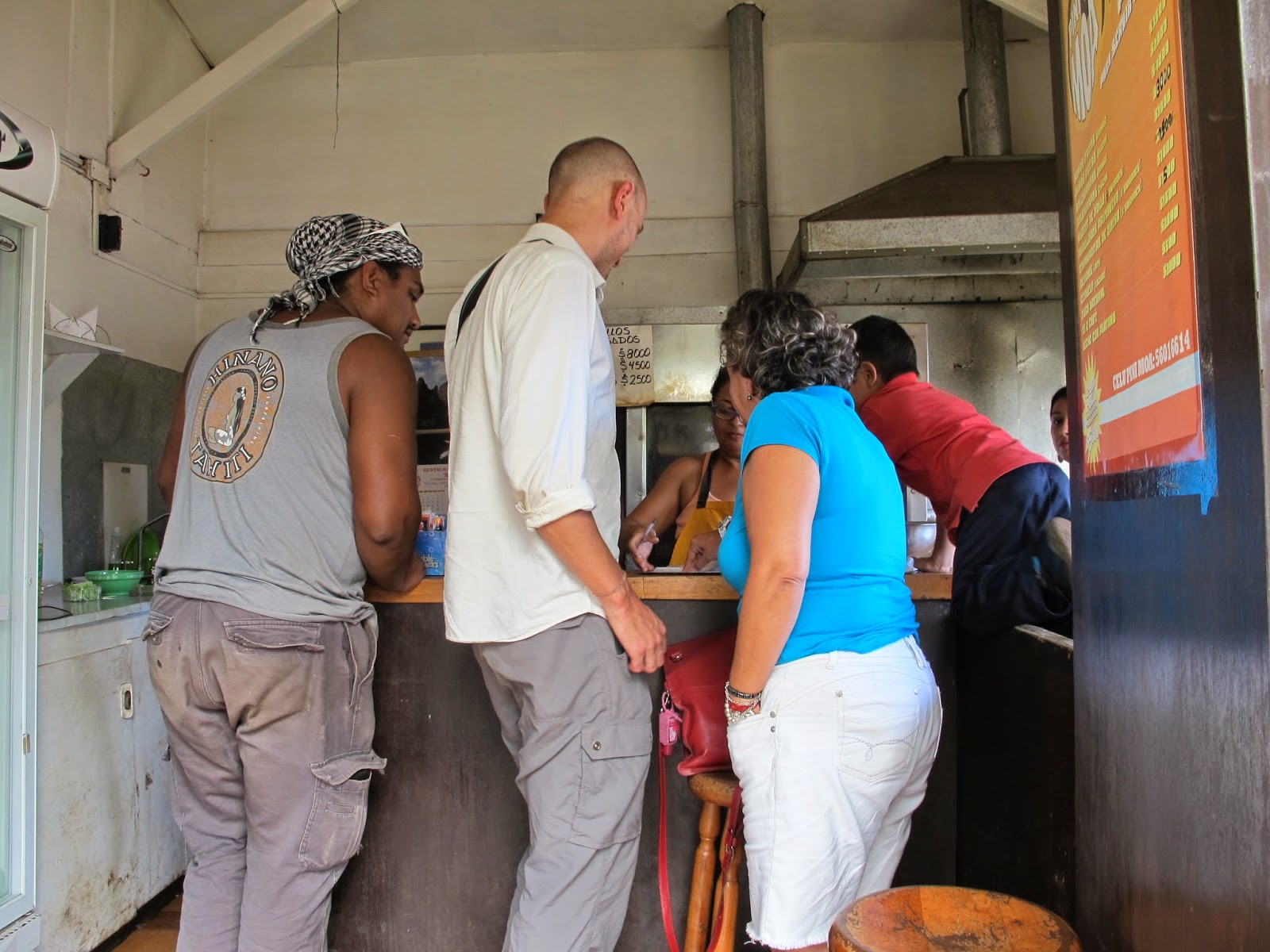
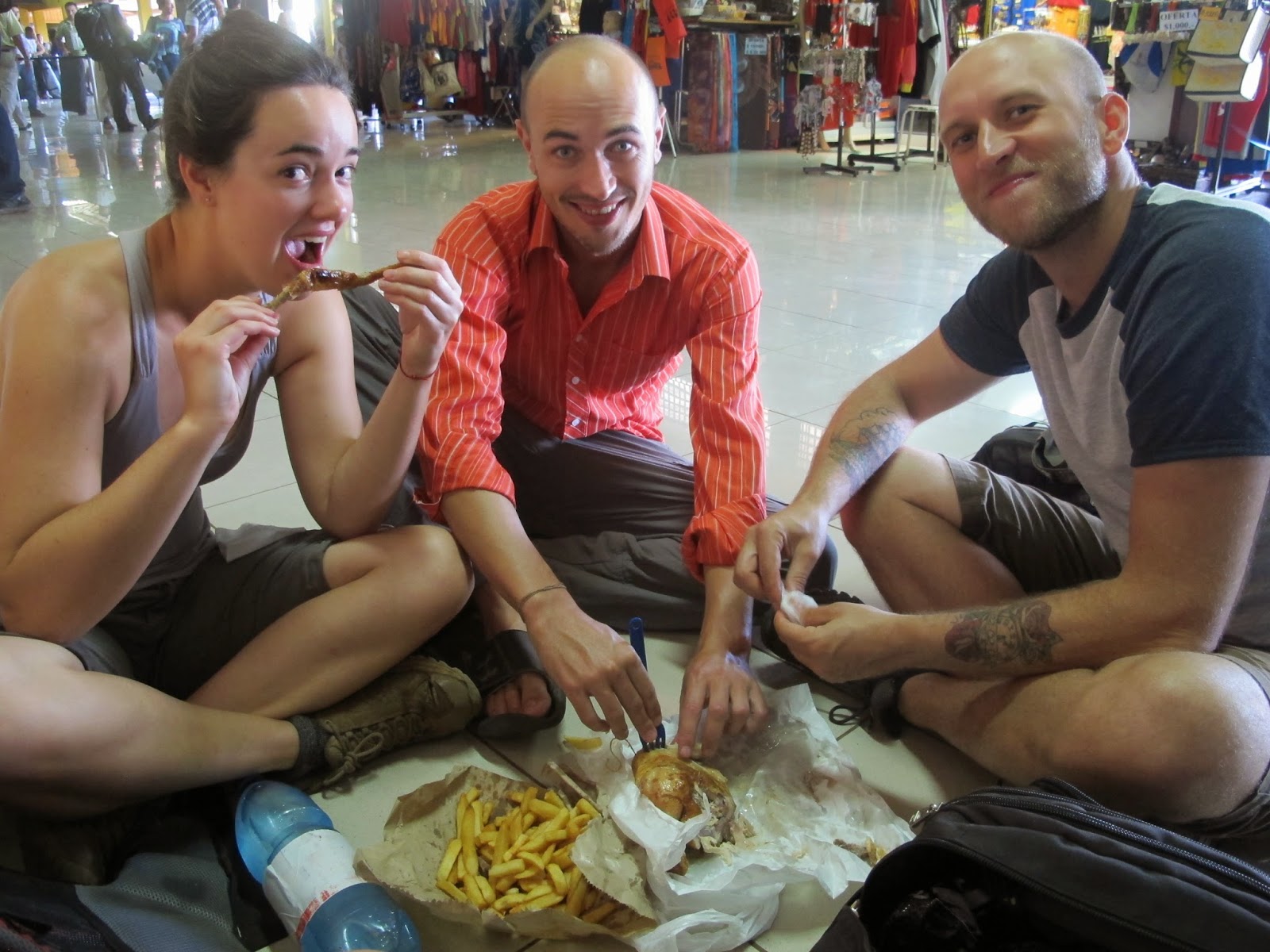
We gathered our belongings and headed to the airport to check in. With such a tiny airport, just on the outskirts of town, the guys felt there was enough time to leave and come back after handing over our bags. Where would that last stop on the island be...a crater, an ahu with moai? There was only one last place to say goodbye to...


Eating one last meal of Chicken & Chips
on the airport floor.
Back on the mainland, we took a day to organize ourselves, buy bus tickets, and wash the dirt and sweat out of our entire wardrobes.We were understandably run down after so much exercise and three time changes all within one week. Like Antarctica, it was difficult to think onwards after leaving such a magical place. But real adventurers never pause long, so tomorrow will be a new day exploring a new city. Stay tuned!