Showing posts with label 16. Chile. Show all posts

Saturday, May 24, 2014

Travelling Gluten-Free & Lactose-Free in South America

Travelling with food allergies or restrictions isn't easy, particularly in Argentina where bread is a main part of the diet (breakfast in most places is just pastries, snacks are empanadas...). To help others in my position (and for my own benefit if we return to these countries), I've compiled a list of places where I found gluten-free/dairy-free products. I hope others find it helpful!

ARGENTINA
Buenos Aires:
Carrefour Piedras, Piedras 383 has a decent sized selection of cake mixes, sweet crackers, rice noodles, etc. It was better for the gluten-free traveller than the gf/df one, but this supermarket had better selection than most I went in to.


Puerto Iguazu:
Supermercado Ruta 17, 3370 Av Victoria Aguirre has an extremely limited selection of gf/df biscuits made by Dimax Alimentos...I wouldn't exactly call them tasty, but in a pinch, they were edible. For a night out, try the Wok and Grill, Av Misiones 125, for a change of palate. They have gluten-free soya sauce.

Mendoza:
I disappointingly didn't find my regular selection, or any selection of gluten-free products at the Carrefour on Av Gral Las Heras, Mendocinas. This was the only supermarket I had time to look in.

Junin de los Andes:
This is a small town with one main street that you pass through on the Seven Lakes drive between San Martin and Bariloche. About half way down the street, on the East side, there's a grocery store. Here, I found boxes of brownie, cake, and pancake mix by a company called Exent. These are gf/df and delicious. I especially enjoyed the ease of making pancakes in the morning with only an egg and some water!

Bariloche:
Quinoa Dietetica, Albaraccin 711, is a store dedicated to gluten-free foods. There are non-perishables like cookies, crackers, and pastas, as well as a freezer full of fresh/frozen empanadas, pizzas, and bread. Unfortunately, there are hardly any lactose-free products, and what they do have is all non-perishable.
La Anonima on Albarracin 601 had a small area of gluten-free products with sadly only one type of Santa Maria cookies. Maybe they just hadn't had a shipment in a while?

El Bolson
La Anonima on San Martin also had a good supply of gluten-free/dairy-free crackers, granola bars and pasta.

El Calafate:
La Anonima, Av del Libertador Gral San Martin 902, had Santa Maria products, which are boxed cookies of different flavours (chocolate, vanilla, chocolate/vanilla, lemon, scones, jelly...) that all taste the same but are pretty good. They did not have any rice/corn pasta substitutes when I was there.
The small grocery store by the bus station, on the SW corner of Julio Argentino Roca & San Juan Bosco, had a bag of rice pasta that wasn't the best (got pretty soggy) and there wasn't any other gf/df products in the store, but I was thankful to find something.

El Chalten:
This tiny town is not the place to go to find groceries. Everything is also expensive because it's shipped in. Bring provisions from El Calafate. BUT there is a fantastic little place called La Cervezeria at 564 San Martin with gluten-free pizza, pasta and tostadas (and the biggest glasses of wine you've ever seen!).

Ushuaia:
La Anonima, Av San Martin 1506, has a full selection of gluten-free/dairy-free products such as Santa Maria cookies and crackers, pasta substitutes and granola bars (pictured right). This was a great place to stock up. The other Anonima at Gdor. Felix Paz 190 had some types of Santa Maria cookies but no granola bars when I was there.


URUGUAY
Colonia:
I was delighted to find boxes of chocolate Gullon cookies at a little supermarket on the SW corner of Av General Flores & Washington Barbot. These are some of the best gf/df cookies I've ever eaten!

Montevideo
We weren't there long and I didn't find any gf/df products at the grocery stores I checked in the old city.


CHILE

Pucon
I had read that Chile has less laws on packaging and it's more difficult to find food substitutes, but I was amazed by the selection of products at the Supermercado Eltit on Av O'Higgins between Ansorena and Fresia. Coming from Argentina, it was exciting to find foods such as peanut butter, taco seasoning, and delicious gf/df products by Noglut. They had animal crackers and chocolate cookies that were such a treat! These are also the best rice crackers I've ever had.

Talca
We weren't in Talca long and I didn't find any products at their stores.

Santiago
The supermarket at Huerfanos & Amunategui had a disappointing selection of products considering its size. They had a few gf cookies that weren't df. A much better grocery store was the Express at San Martin & Gnrl Mackenna (close to Plaza des Armas). They have a large imported selection, a great variety of gf/df cookies such as the Gullons I mentioned earlier and some coconut cookies that were also good. (They also have a fantastic selection of wine!).


This is just a recap of what I found in these three countries. Of course, things change. I might have visited some on a day soon after restocking, or when they were understocked. Feel free to add comments if you find other stores or that things have changed. It's challenging to travel with food restrictions, so we've got to all stick together!

Thursday, May 22, 2014

Day 291: Adios South America

Punta del Este, Paraguay glimmering in the background


Nearly two years ago, we stood on the salt flats in Bolivia and took a photo of Erin waving at two countries that were new to us at the time. Those countries were Argentina and Chile. As if to bookend our explorations this year in South America, our time here re-encapsulated that moment. On our last day of our South America leg, we walked to the 3 Corners of Iguazu, and stood and waved at two new countries to explore: Brazil and Paraguay. When we'll return is not known at this time, but it's always exciting to leave with the knowledge that there's more to come back to.

We shared melancholic sunset drinks looking out over the river, reminiscing over our time on the continent. We'd been here just shy of four months and would be leaving from the same place we arrived. To complete a full circle on our continental tour, we'd fly the next day out of Buenos Aires, onwards to Central America. The fact that Nicaragua would be our last country of the trip made this evening especially sad.


South America gave us some truly exceptional memories. We enjoyed the ease with which you can travel, and the comfort of first class buses, lush accommodations, and the joy of cooking and eating raw fruits and vegetables without worry. We ate parilla, marvelled at milongas, meandered through picturesque towns, and observed wildlife. South America gave us the gateway to explore onwards to the trip of a lifetime, Antarctica. But it's time to move on and see somewhere new, and it's almost time to return home.


As a way of sharing our best experiences with you, we'll leave you with our South American video. Compiled by Craig, it is set to an appropriate tune, Apertura by Gustavo Santaolalla from the Motorcycle Diaries soundtrack, a movie about the early life of Che Guevara. We hope you enjoy it and that it inspires you to explore the world.


Wednesday, May 14, 2014

Days 283-286: Nowhere to Call Home

We woke up to an eerie calm the next morning as May 1 was a holiday. Halfway to the bus station and still on foot we were thankful when we were able to flag down a taxi (even if we did pay an unofficial 50% holiday price increase) to take us the rest of the way. Excited to be moving onwards, back across the border into Argentina, we were shocked to walk up to the booth and see a sign reading "Paso Cerrado." The attendant shared with us, dispassionately, that the border and entire pass between Chile and Argentina were in fact closed to all traffic.

Flabbergasted, we all stood in the bus terminal trying to come up with a plan. We had nowhere to stay, nothing was open, and we had no food to eat. The taxi driver asked for over double the price to take us back to our apartment building, a price which we absolutely declined; so feeling defeated, we collapsed into seats at a hotel cafe across the street. Thankfully, they let us use their wi-fi so we could come up with a Plan B. We had no idea when the border would open up again, beyond a "maybe Saturday or Sunday" from the unfriendly bus company staffer. To make matters worse we had a flight to catch from Mendoza in five days' time.

It was our newly made best friend Doris to the rescue. For the third time, this Air BnB owner hooked us up with an apartment in the 1400 Huerfanos building; a place that was quickly beginning to feel like home. So back we went, bags and all, to find a room in Tower C (our third of four towers in the building). The guys roamed the streets for something - anything that was open where we could buy food and wine, though wine was in much shorter supply and a much higher priority; meanwhile the girls waited for the keys to our apartment. Within a couple of hours, we had settled back in with our wine glasses full to the brim with red, bought via a transaction underneath a metal gate from the street. We guess that the store owner was worried about planned May Day protests turning into a more riotous event.

A heavy police presence was there just to prevent that from happening on the streets; however they could not stop the riot in the apartment as each bottle flowed into the next while we made the most of a day gone wrong and laughed over movies and cards.

In the subsequent days, we made good use of all the extra time on our hands. We silently worked side-by-side on our respective blogs, to the point that Kristen and John were ready to launch theirs. For a look at their take on South America, and to follow them as they continue onwards/catch-up to where they are, visit: http://ourwanderland.com/. (They've just posted their take on our Antarctica adventures).

Two days later, we hesitantly made our way back to the bus station with our changed tickets in hand. We all breathed a sigh of relief when the bus took off from the station, heading North, then East, through the Andes. The drive was surprisingly spectacular. We wound our way up through the snowy pass and caught a glimpse of Acongagua, the tallest mountain in South America with the help of GPS on our mobile devices. Though we had ascended as near to the Heavens as roads could take us, the border crossing was nothing short of Hell. It took three hours of standing around or squished in the hot bus for every passenger to exit and enter the two countries. All of our luggage was unloaded and our handbags were searched manually.


Once on our way, the rest of the drive was just as lovely as the Chilean side, but less snowy and more bad-landsy. Red cliffs gave way to winding blue rivers, which flattened to a desert plateau. We pulled into Mendoza an hour late, found our hostel, and enjoyed a delicious steak dinner with K&J and two new friends, Amanda and Ryan, Quasi-Calgarians we met on the bus. Good food and great company was the perfect end to a stressful day.

Tuesday, May 13, 2014

Day 282: Valparaiso


From April 12 to April 16, fires raged the hillside of the coastal city of Valparaiso. 6,000 citizens were evacuated from the city and 11,000 became homeless in an instant. The city was placed under red alert and declared a disaster zone. Blackouts occurred, and with them, the looting of businesses and homes. It is one of the worst disasters in Valparaiso's history. We were meant to visit on April 16.


On April 15, the four of us held a pow-wow to decide our plan. The fire, at that point, was under control, but still burning. Relief efforts were underway in Santiago as the city rallied to help its neighbour. Not wanting to get in the way or put extra stress on the local infrastructure, we opted not to go. A quick change of plans gave us an extra day upon our return from Easter Island for a day trip. Unsure of what to expect because of the recent disaster, and mixed reviews from friends and family who had visited previously, we boarded a local bus early in the morning and threaded our way through the hills towards the coast.

Not fire damage, just a regular part of downtown.


Our first impression had fulfilled our worst expectations. The city is gritty, with much dirtier streets than Santiago, and people shouted for our attention while we navigated the narrow sidewalks through the crowds and traffic. Although on the water, the area we walked was more port than pedestrian, since we weren't dropping off cargo in a huge truck we felt a little out of place. We walked all the way down the main strip, passing a few old, dilapidated churches and heritage buildings along the way; down each alley we saw homeless men picking through piles of garbage.


Not wanting to give up so soon, and enticed by a piece of street art we could half-see, we followed a sloped road up one of Valparaiso's 45 hills and around a corner. The street art grew and spread, blending from one wall into another, until we'd climbed our way up a rainbow staircase into an artistic barrio that had been completely swallowed by the ever-changing, swirling kaleidoscopic world of spray paint gradient and fantastical figures that leapt off the wall.


This part of the city felt much safer than where we'd been walking below. The paintings were colourful and friendly, sometimes sad, and usually breath-taking. We stopped to watch an artist work on her newest addition to the neighbourhood. The art was creative but well ordered, it did not seem that any were covered up by others or whitewashed away. The only interruption to a piece was likely caused by the ever-moving ground beneath the walls; patching of cracks and holes required repainting, but always with minimal effect on the art.


Listening to our rumbling stomachs, the four of us stopped at a cute bistro with a pleasingly retro decor, and skimmed the menu. We could barely understand all the unusual ingredients, that even when translated meant nothing to us. Those that we did understand only increased our eagerness and made our decision more challenging. After some discussion, we landed on the rabbit and the salmon, with a bottle of Anakena red wine to share as a tribute to Rapa Nui's sandy beach.


Glasses raised in a cheers, a sudden shaking brought us nearly to our feet, while our waitress struggled to stay on hers'. The whole building rumbled to life as if picked up by a giant and briefly examined. Before we could react, it was over, the restaurant erupting in nervous laughter. "Not an earthquake," our waitress reassured us. "Just a tremor." Needless to say, she'd been through worse in her young life. This one registered a 5.3 on the Richter scale.


After our delicious meal, we wandered our way back down a different street and landed at one of the three working funiculars that run up and down Valparaiso's steep cityscape. An experience in itself, the funicular brought us safely to the doorstep of an artisanal brewery that the guys just couldn't pass up.


Our final verdict was that the city was enjoyable with may treasures to discover. We would go back just to sample more food, wine, and beer, but the main draw is the colourful houses and rampant street art. We would recommend getting away from the basin and up into the hills where traffic thins out, and the views improve.

Monday, May 12, 2014

Days 280 & 281: Iorana Rapa Nui


The next morning, we were able to have a relatively casual wake up as check out was 10 am. There were a couple of hours left for lazing around reading our books and exchanging photographs. Erin was just finishing Easter Island by Jennifer Vanderbes, and she shared with the rest of us a passage that felt particularly poignant:

The Statues didn't look out to the sea as one would imagine; they faced inward, staring at the island, their backs to the ocean, as if these people, thousands of miles from other humans, had, over generations, lost knowledge of the outside world.  As if in building these monuments, megaliths of the past with which to encircle themselves, they had forgotten, or tried to forget, that anything lay beyond their shores.

What, then, would they have thought the day Roggeveen anchored off the coast, the deck of his massive ship topped with goods they had never before seen, the men in a rainbow of brightly colored hats and jackets and epaulets? What would they have thought as they paddled alongside in their corroding canoes, climbing aboard to stroke the sleek sails and tim and ropes?  What would they have thought when Roggeveen's men rowed ashore, climbing the rocks with polished pistols and muskets at their sides, which, when raised, seized life in an instant?  What would they think, three days later, as they looked at the bodies of their fallen friends while the ship sailed off beyond the edges of the world they had thought their own?  Would the islanders have looked around at the barren landscape?  The rocks and the reeds and the yellowed grass?  Would they remember the trees? Or stories of trees. Would they look at the few canoes rotting in the surf?  Boats that could hold no more than four people each, too leaky to make it more than a few miles?  Would they know they were sharing the tragic fate of so many creatures, like the intrepid birds that had found their way to such distant shores and awoke one day to find they could no longer fly?  Would they then look up at the massive stone giants they and their ancestors spent centuries building?  At their own history, now no longer enough to protect them, to keep out their knowledge of another world?

Was this the moment when one furious man gave the command--Enough!  Never again!--when they knew the dead had betrayed them, when they swarmed the nearest statue, their bodies heaving, angry, frightened by the weight of this massive relic, bleeding themselves for the sake of a new beginning?

We don't know for sure the history of Easter Island. We have only the presumptions of anthropolgists and researchers and the stories of passed-down legends. To discover all of Rapa Nui's secrets, you'll have to go yourself.


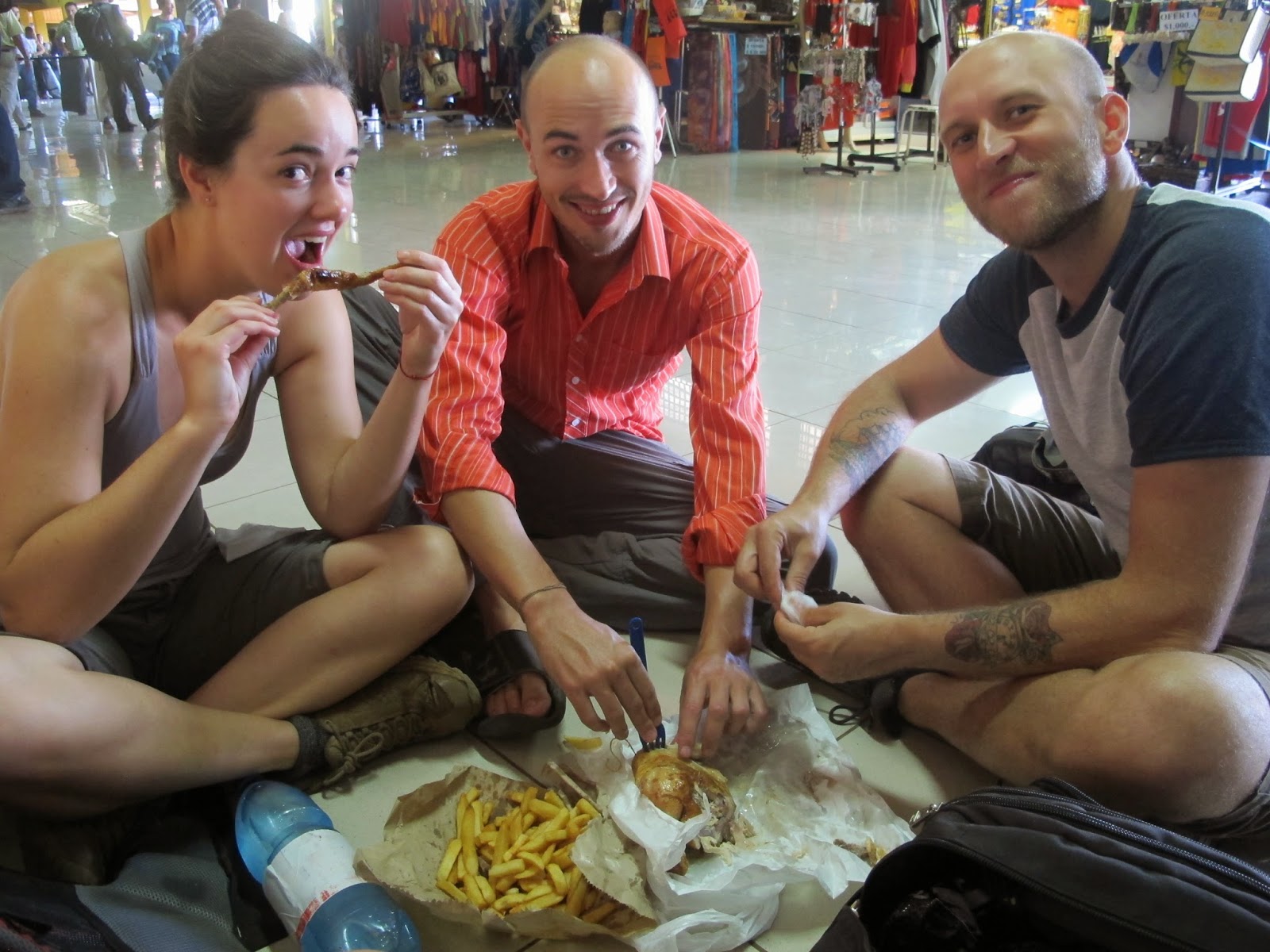
We gathered our belongings and headed to the airport to check in. With such a tiny airport, just on the outskirts of town, the guys felt there was enough time to leave and come back after handing over our bags. Where would that last stop on the island be...a crater, an ahu with moai? There was only one last place to say goodbye to...


Eating one last meal of Chicken & Chips
on the airport floor.
Back on the mainland, we took a day to organize ourselves, buy bus tickets, and wash the dirt and sweat out of our entire wardrobes.We were understandably run down after so much exercise and three time changes all within one week. Like Antarctica, it was difficult to think onwards after leaving such a magical place. But real adventurers never pause long, so tomorrow will be a new day exploring a new city. Stay tuned!

Sunday, May 11, 2014

Day 279: Summitting the Volcano


After watching the rain pour down around us both previous afternoons, we knew it was essential to wake early if we wanted a shot at panoramic views from the island's highest point. The only wrench in the plans was finding out a couple of hours before bed that the time 'might' be changing the next day. No one seemed to know for sure and our scattered internet wasn't helping much, so we set an alarm based on when we knew the sun would be rising and figured we'd wing it the next day. Even by morning, the few people we saw were confused as to what time it was.

Really, it didn't matter too much to us. We walked the deserted road towards town and eventually flagged down a taxi driver picking up his morning empanadas. He took us back to Ahu Akivi via a different road, one set inland, which gave us breathtaking views of the rising sun behind the volcano we'd soon be climbing. When we reached Akivi, we were once again the only tourists around. This time; however, it was also void of grass cutters. We took in the sounds of early morning insects, an occasional horse's neigh, and the faint roar of the waves against the distant coast.


These are the only moai who face the water, but really, they're like all the others who face where the village was. Craig threw out his own theory, that they face the direction that the Polynesian settlers came from (a theory that inernetting shows he was not the first to think of). 

After our fill of these regal men, we turned upwards and skirted a field along a wide dirt road. The air was just starting to warm up and the light breeze made our steady climb peaceful. Huge fluffy clouds strolled past a sky now so blue you'll swear we over-edited the photo.


As we crested each rolling hill, we were provided with increasing views of the island, and with them, reminders of what the past six days had brought us. We were able to identify Rano Kau, where we knew Orongo perched perilously on the edge between crater and cliff, the road that led to the fallen moai from our second day's picnic. The rehabilitation area where we'd planned trees came into view next, a patch of trees just restricting a full 360° of water. Craig pointed out the top knot crater from our rental car day, and the crater lake of Rano Raraku. The beauty of hiking to the top of the island on our last day unfolded around us, each field, hill, and valley a piece in the story quilt of our visit.


A wind had picked up and with it grey clouds, so it looked like we might get our morning shower a little early. And although lovely, the views from the island's peak weren't quite as spectacular as we'd hoped because it wasn't much higher than the peaks around it. So we quickly turned around and strolled down the gentle slope to the road.


As hard as we tried, we could not find
 the mythical anatomically correct unibull
Having already explored the North Road to our fill, we opted to stick to the main street so we'd return quicker and have the option of hitchhiking if it presented itself. A very nice old man stopped us, going the opposite direction, to let us know he was on his way to Akivi in case we wanted to see the moai. We passed a few small houses and Erin was able to use her Rapa Nui for the first time (that she'd learned in the novel she was reading and wouldn't stop quoting), reciprocating the friendly call "Iorana" back to two young sisters.


Nearing town, a man in a pick-up stopped to let us know he was going to the church, which we wanted to visit anyways, so we jumped in and shaved the last ten minutes off our hike, for which our feet were thankful. A quick peek inside told us we'd unfortunately missed the lively Rapa Nui service that morning and instead it was a regular Catholic service in Spanish.


After lunch and an afternoon's rest, we circled the coast with Kristen and John intent on a special farewell dinner at our seafood restaurant from Day One. We arrived to discover it was closed on Sundays so after checking out a few other options, we went our separate ways and cooked at home.

Saturday, May 10, 2014

Day 278: An Introduction to the Island


Better late than never. We awoke to sunny skies and a salty breeze and relished not needing to set an alarm or jump out of bed. We leisurely made pancakes, then Erin, Kristen, and John walked the coastal road, past the cemetery, in order to visit the island's museum. It had been our intention to do this first, for an overview of what we'd see, but it was closed the day we arrived and we'd been too busy ever since. In the end, it was nice to have explored the sites on our own, taking in what we saw, then filling in the final details with the information we hadn't already known.


The question Erin's sister had asked her before the trip still lurked in her mind: were the heads on the hill complete? We hadn't been able to find a decisive answer at the quarry. It seemed that they might be only half-completed moai, their bodies not excavated and carved yet. But the museum posed another possibility.


Scientists think that the moai were carved horizontally, on their backs, out of the volcanic rock. This certainly seems to be the case from what we witnessed at the quarry. Then, they believe the moai were tilted upwards in a hole so that their backs could receive their final carvings. It seems likely that the heads on the hill were in this stage of production, which is why some have started leaning over time, but they are mainly upright. When the beliefs of the Rapa Nui changed, the moai were abandonded. Some are even found scattered around the island on their way to ahu. We also learned the startling fact that there are 887 moai in total, 288 were moved and erected on an ahu, 397 are still in the quarry, and 92 were left en route to an ahu. The last hundred are only fragments or found in museum collections. Only 10 of the moai resemble female figures.


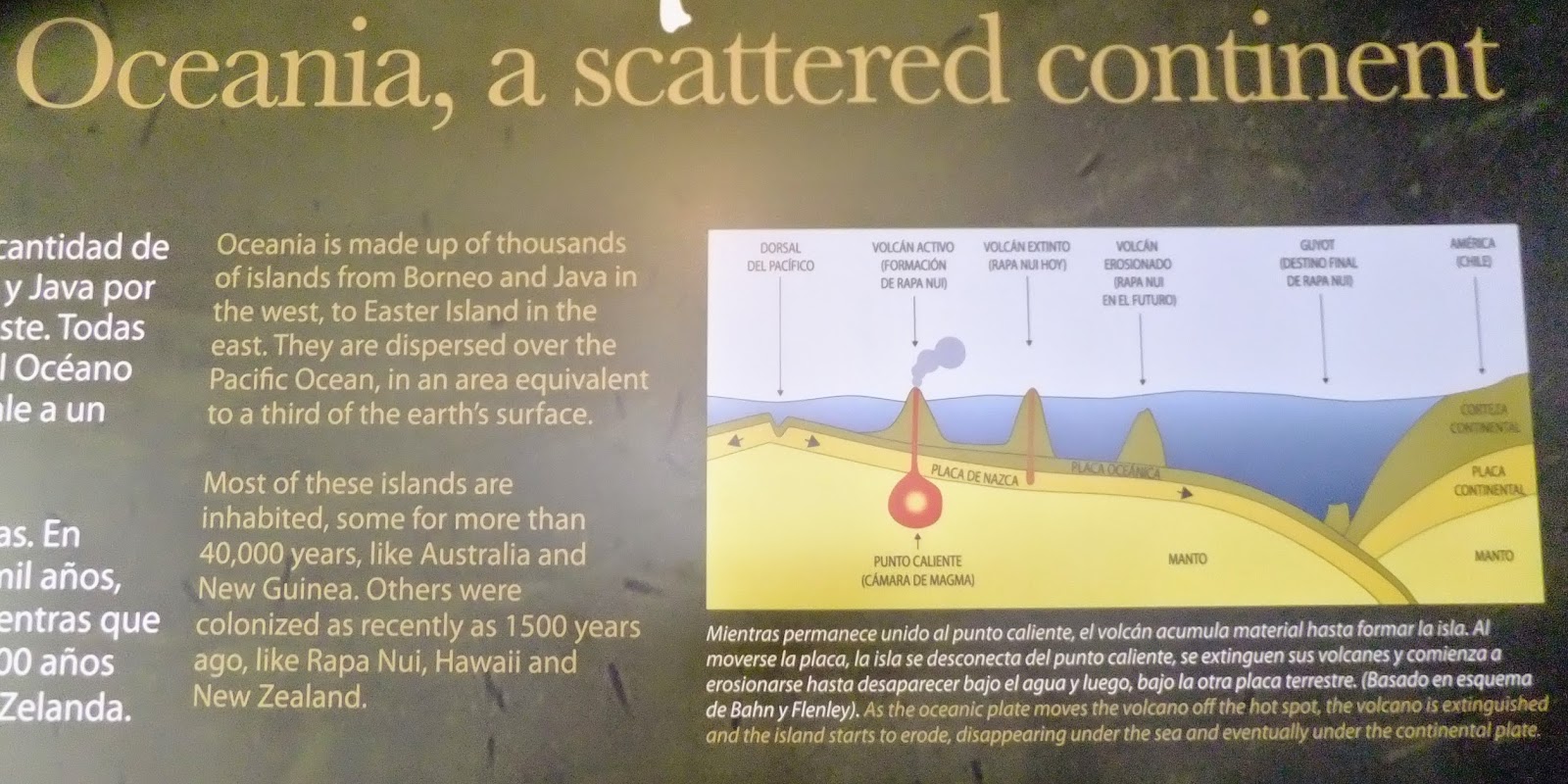
The best news the museum presented were the multiple panels dedicated to information about Oceania, showcasing how Easter Island (and Borneo) are a part of this seventh "continent," meaning we've actually been to all seven! We know, however, that this glory is short-lived as it will surely be disputed by Craig and his family.


One of only 10 moai
with female figures
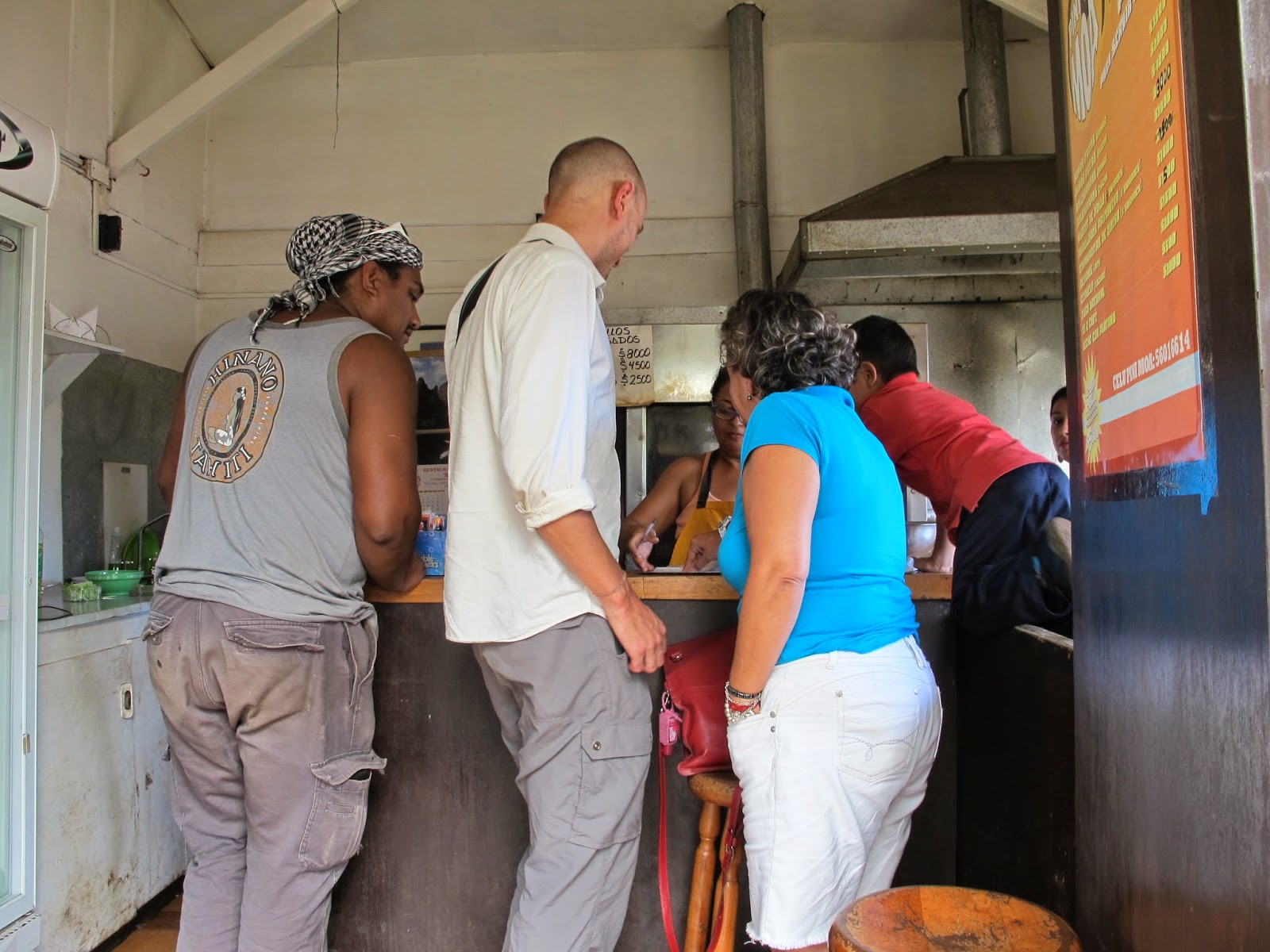
It was a casual walk back across town with a less-spirited discussion about having chicken and chips for lunch. None of us were in the mood to get our hopes up for a third time. So it was a surprise when we entered our usual grocery store to see well-stocked shelves and a whole chicken turning on a spit in the back corner. The latest plane must've brought provisions for our little market, or it was a special treat for Saturday! We nervously waited for our turn in line at the deli counter, hoping the last chicken wouldn't be sold and were relieved to discover there was not one left, but two, and we could have our pick! A simple decision (one was substantially larger yet they were the same price...), then a lengthy discussion about whether we should still walk up the road for a huge plate of chips or buy our preferred, yet more expensive avocado, tomato, and green pepper sides, and in the end, John offered to make the extra ten minute trek to see if the shop was open. Erin and Kristen continued on home to share the good news with Craig, and the three of us cheered when we saw John approaching home victorious.


Within minutes, the sky opened up and the rains the clouds had been promising poured down on us in an absolute monsoon. We thanked our bank accounts for having enough in them so we weren't stuck in a tent in the downpour, and went our separate ways for an afternoon of relaxation.


Thursday, May 8, 2014

Day 277: On the Road Again


With not even a gleam in the sky's eye, we were up and on our way. This time, Craig was at the wheel of a manual transmission, which meant it was not a smooth start. Considering the jeep was falling apart, had a terrible clutch, and Craig's limited experience, Craig did well making it to the second half of the day before his first stall. Though it is a miracle that no one got whiplash during the first few gear changes.


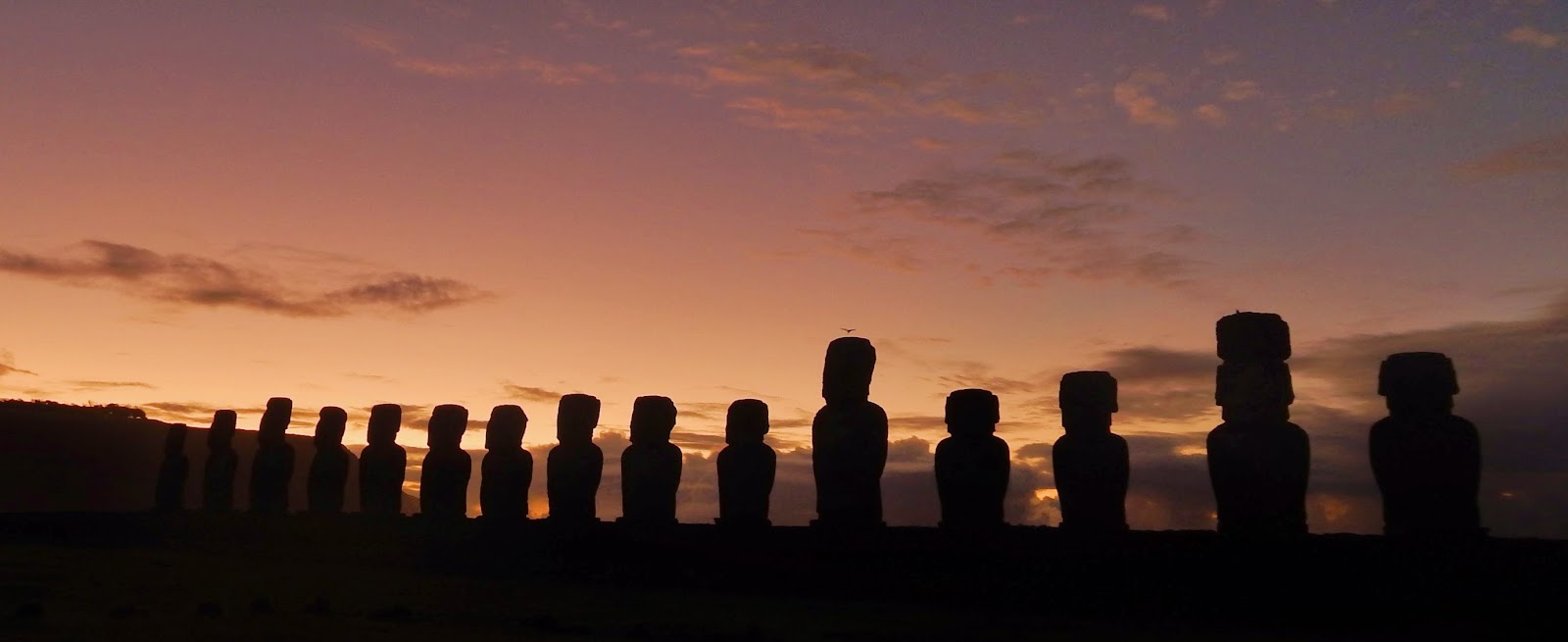
Navigating the dark island was easy, even if signs were put at the turn-off or sometimes after. A few scooters sped past us; anyone who was awake at this hour was heading to one spot: Ahu Tonga Riki. Fifteen moai lined up along the sea. The peninsula we visited the day before would gently block the rising sun behind them.

We laid plastic bags out on the dewy ground, then watched and waited as the silhouetted behemoths looming above us provided the screen for a dazzling light show. That moment when our eyes adjusted and the sky lightened just enough so that we realized we could see the moai gave us goosebumps. The sky slowly evolved from ink-black to deep navy to patches of yellow-white; then just when we'd given up hope of a colourful sunrise, streaks of pink and purple appeared. Captivated by the early morning sun as it hit the cliffs and green craters around us, we lingered longer than most.


Timed perfectly, we arrived at Rano Raraku at 9:01 am. As it opens at 9, we only had to wait 15 minutes for the park workers to unlock the gate. Also known as the Quarry, this is where the moai were cut from the stone of the outer crater wall. Walking around it gave us the feeling that it was truly a moai factory. When they fell out of fashion, the moai were abandoned in various states of completion. Some are vague outlines etched into the mountain, others are ready to be painstakingly shipped across the island, but the most iconic image is of those that had been stood upright in pits to allow for the carving of designs on their backs.


We now know that time and soil erosion led to those pits becoming filled, leaving only a head, and sometimes less, peaking out of the ground at all angles.


The sun was just beginning to graze the edges of the shallow slopes which the moai adorned. Beneath us, we could see "the 15" as the sun hit the waters of the bay behind them, gilding the mist of the advancing tide.


We were completely alone, standing in awe at each new view, inhaling deeply in the hopes that it might help us remember the moment.


Erin was very excited to find the exact spot the picture she had seen as a girl was taken; it was the photograph that instilled in her a desire to visit Easter Island.


We ventured up into the crater afterwards, but disappointingly, the signage was quite confusing and certainly gave us the feeling that the loop around the marshy lake at the crater's centre was off-limits.


A few tour groups pulled up so we quickly left, not wanting our magical memory of the site disturbed. Back on the road, we went to the north coast of the island, stopping to see a few pieces of rock art and a rock with holes in it. The Rapa Nui used to blow into the hole, which made a noise they believed attracted fish to the shore. It was meant to bring good luck to the fisherman.


Our friend at the hostel, Isabel, had previously rented a car and warned us against going too quickly on the small island lest we do everything in half a day. With this in mind, we lingered at the petroglyphs, listening in on what the tour guides were saying in French or Spanish, and took our own quiet moment at the some weird energy rock at the Navel of the Earth (maybe we should've gotten a tour guide?).


By this time, our stomachs were rumbling, along with the gathering clouds overhead, so we high-tailed it to Anakena, the one of only two sandy beaches on the island, to ensure we had at least a few moments of sun in the surf. As the rest of settled in to have a picnic lunch, Craig fought through thick bush to get a view of the moai with the beach in behind them.


Then we all sat on the wonderful South Pacific sand and shared lunch. The next couple hours were spent lying on the beach and swimming in the calm, cool, and crystal clear water. We've read that Anakena had been formed by a tsunami years ago. Legend also states that it was the landing site of Rapa Nui's first settler, Hotu Matu'a. It was also used as a ceremonial place by the Tangata manu (Birdman).


After our home-made lunch and fresh pineapple juices from a stall, we drove around the corner of the rocky outcropping to take a peek at the other, much smaller, sandy beach. O Vahe is a secluded crescent of sand beneath a rocky ledge. It's off-limits for visiting because of the falling rocks that tumble down from the cliff above. We noticed a couple who were ignoring the warning signs and having their own private picnic and swim and tsked them from afar (but were secretly really jealous!).


Heading back south on the island, while looking for a turn-off, we passed a sign pointing to the right with a long unfamiliar name. Since it was nearly completely obscured by trees, we were not sure if it was the correct road or not. We figured we might as well explore. The hard-packed gravel and smooth asphalt of the rest of the drive gave way to mud and deep ruts. At a fork in the road, we stayed on the more well-trod path, though we should have listened to Walt Whitman. A tree had fallen across the road, thus requiring Craig to preform a three-point turn on a hill in the mud. Unphased, we continued on, but were turned back shortly after when the mud turned to wet clay and the jeep began to slide. Winter driving experience helped as the vehicle slowly began to spin. Bringing it to a stop, Craig promptly turned us around and retreated to the main road. That's when we saw that a sign stood to our right, after the turn-off, indicating that no vehicles were allowed on the road. Maybe it is a cultural thing, but we would put that kind of sign before a driver would turn onto a forbidden road.

More fallen moai with rolled away pukao

We managed to find our true turn-off further down the road, which brought us to a rather unimpressive look at the ancient topknot quarry, Puna Pau. After Rano Raraku, it was certainly a disappointment; a few red topknots lay on the grass, lonely without their owners. Topknots, or pukao, were carved from this red volcanic stone, and made to represent the hairdo of the Rapa Nui of the time. Much more impressive when adorning a moai, these hats can be up to 2.5 meters by 2.5 meters. They were carved with a slit in them to sit upon the heads without falling.


The rest of the day was spent driving the South-West road and revisiting the crater Rano Kau that we saw the first day. We attempted to get chicken and chips once again, but were denied the greasy pleasure and instead grabbed groceries for a home-made meal. Kristen, the only one of us who was inspired enough to think of an alternative to chicken and chips directed us so we managed to pull together fried potatoes topped with salami, tomato, green pepper, onion, garlic, guacamole, poached egg, and cheese, with sliced apples drizzled in honey caramelized on the stove-top for dessert.. We broke our detox in order to share a bottle of late harvest we'd brought from Santiago.