Sunday, May 11, 2014

Day 279: Summitting the Volcano


After watching the rain pour down around us both previous afternoons, we knew it was essential to wake early if we wanted a shot at panoramic views from the island's highest point. The only wrench in the plans was finding out a couple of hours before bed that the time 'might' be changing the next day. No one seemed to know for sure and our scattered internet wasn't helping much, so we set an alarm based on when we knew the sun would be rising and figured we'd wing it the next day. Even by morning, the few people we saw were confused as to what time it was.

Really, it didn't matter too much to us. We walked the deserted road towards town and eventually flagged down a taxi driver picking up his morning empanadas. He took us back to Ahu Akivi via a different road, one set inland, which gave us breathtaking views of the rising sun behind the volcano we'd soon be climbing. When we reached Akivi, we were once again the only tourists around. This time; however, it was also void of grass cutters. We took in the sounds of early morning insects, an occasional horse's neigh, and the faint roar of the waves against the distant coast.


These are the only moai who face the water, but really, they're like all the others who face where the village was. Craig threw out his own theory, that they face the direction that the Polynesian settlers came from (a theory that inernetting shows he was not the first to think of). 

After our fill of these regal men, we turned upwards and skirted a field along a wide dirt road. The air was just starting to warm up and the light breeze made our steady climb peaceful. Huge fluffy clouds strolled past a sky now so blue you'll swear we over-edited the photo.


As we crested each rolling hill, we were provided with increasing views of the island, and with them, reminders of what the past six days had brought us. We were able to identify Rano Kau, where we knew Orongo perched perilously on the edge between crater and cliff, the road that led to the fallen moai from our second day's picnic. The rehabilitation area where we'd planned trees came into view next, a patch of trees just restricting a full 360° of water. Craig pointed out the top knot crater from our rental car day, and the crater lake of Rano Raraku. The beauty of hiking to the top of the island on our last day unfolded around us, each field, hill, and valley a piece in the story quilt of our visit.


A wind had picked up and with it grey clouds, so it looked like we might get our morning shower a little early. And although lovely, the views from the island's peak weren't quite as spectacular as we'd hoped because it wasn't much higher than the peaks around it. So we quickly turned around and strolled down the gentle slope to the road.


As hard as we tried, we could not find
 the mythical anatomically correct unibull
Having already explored the North Road to our fill, we opted to stick to the main street so we'd return quicker and have the option of hitchhiking if it presented itself. A very nice old man stopped us, going the opposite direction, to let us know he was on his way to Akivi in case we wanted to see the moai. We passed a few small houses and Erin was able to use her Rapa Nui for the first time (that she'd learned in the novel she was reading and wouldn't stop quoting), reciprocating the friendly call "Iorana" back to two young sisters.


Nearing town, a man in a pick-up stopped to let us know he was going to the church, which we wanted to visit anyways, so we jumped in and shaved the last ten minutes off our hike, for which our feet were thankful. A quick peek inside told us we'd unfortunately missed the lively Rapa Nui service that morning and instead it was a regular Catholic service in Spanish.


After lunch and an afternoon's rest, we circled the coast with Kristen and John intent on a special farewell dinner at our seafood restaurant from Day One. We arrived to discover it was closed on Sundays so after checking out a few other options, we went our separate ways and cooked at home.

Saturday, May 10, 2014

Day 278: An Introduction to the Island


Better late than never. We awoke to sunny skies and a salty breeze and relished not needing to set an alarm or jump out of bed. We leisurely made pancakes, then Erin, Kristen, and John walked the coastal road, past the cemetery, in order to visit the island's museum. It had been our intention to do this first, for an overview of what we'd see, but it was closed the day we arrived and we'd been too busy ever since. In the end, it was nice to have explored the sites on our own, taking in what we saw, then filling in the final details with the information we hadn't already known.


The question Erin's sister had asked her before the trip still lurked in her mind: were the heads on the hill complete? We hadn't been able to find a decisive answer at the quarry. It seemed that they might be only half-completed moai, their bodies not excavated and carved yet. But the museum posed another possibility.


Scientists think that the moai were carved horizontally, on their backs, out of the volcanic rock. This certainly seems to be the case from what we witnessed at the quarry. Then, they believe the moai were tilted upwards in a hole so that their backs could receive their final carvings. It seems likely that the heads on the hill were in this stage of production, which is why some have started leaning over time, but they are mainly upright. When the beliefs of the Rapa Nui changed, the moai were abandonded. Some are even found scattered around the island on their way to ahu. We also learned the startling fact that there are 887 moai in total, 288 were moved and erected on an ahu, 397 are still in the quarry, and 92 were left en route to an ahu. The last hundred are only fragments or found in museum collections. Only 10 of the moai resemble female figures.


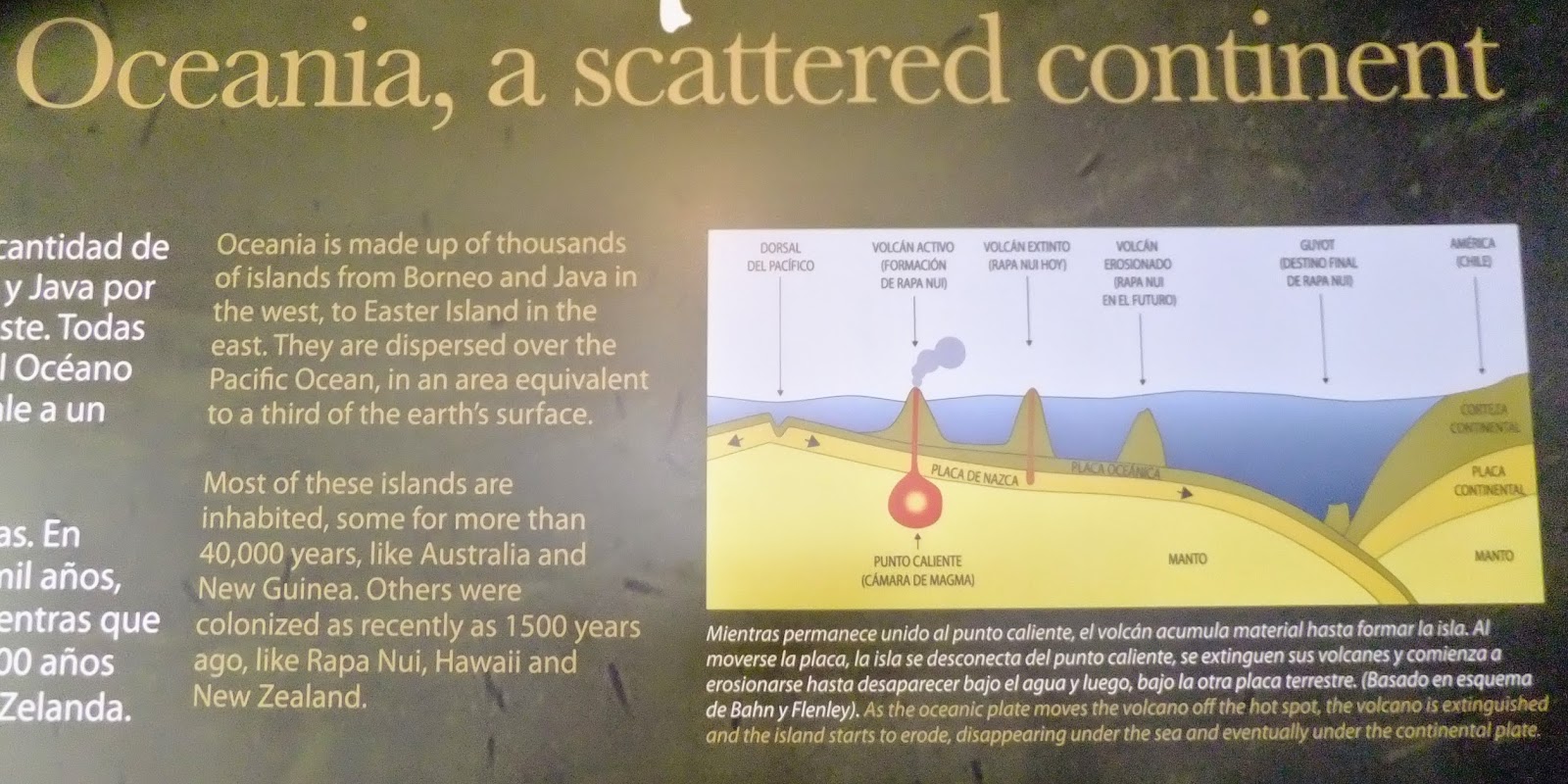
The best news the museum presented were the multiple panels dedicated to information about Oceania, showcasing how Easter Island (and Borneo) are a part of this seventh "continent," meaning we've actually been to all seven! We know, however, that this glory is short-lived as it will surely be disputed by Craig and his family.


One of only 10 moai
with female figures
It was a casual walk back across town with a less-spirited discussion about having chicken and chips for lunch. None of us were in the mood to get our hopes up for a third time. So it was a surprise when we entered our usual grocery store to see well-stocked shelves and a whole chicken turning on a spit in the back corner. The latest plane must've brought provisions for our little market, or it was a special treat for Saturday! We nervously waited for our turn in line at the deli counter, hoping the last chicken wouldn't be sold and were relieved to discover there was not one left, but two, and we could have our pick! A simple decision (one was substantially larger yet they were the same price...), then a lengthy discussion about whether we should still walk up the road for a huge plate of chips or buy our preferred, yet more expensive avocado, tomato, and green pepper sides, and in the end, John offered to make the extra ten minute trek to see if the shop was open. Erin and Kristen continued on home to share the good news with Craig, and the three of us cheered when we saw John approaching home victorious.


Within minutes, the sky opened up and the rains the clouds had been promising poured down on us in an absolute monsoon. We thanked our bank accounts for having enough in them so we weren't stuck in a tent in the downpour, and went our separate ways for an afternoon of relaxation.


Thursday, May 8, 2014

Day 277: On the Road Again


With not even a gleam in the sky's eye, we were up and on our way. This time, Craig was at the wheel of a manual transmission, which meant it was not a smooth start. Considering the jeep was falling apart, had a terrible clutch, and Craig's limited experience, Craig did well making it to the second half of the day before his first stall. Though it is a miracle that no one got whiplash during the first few gear changes.
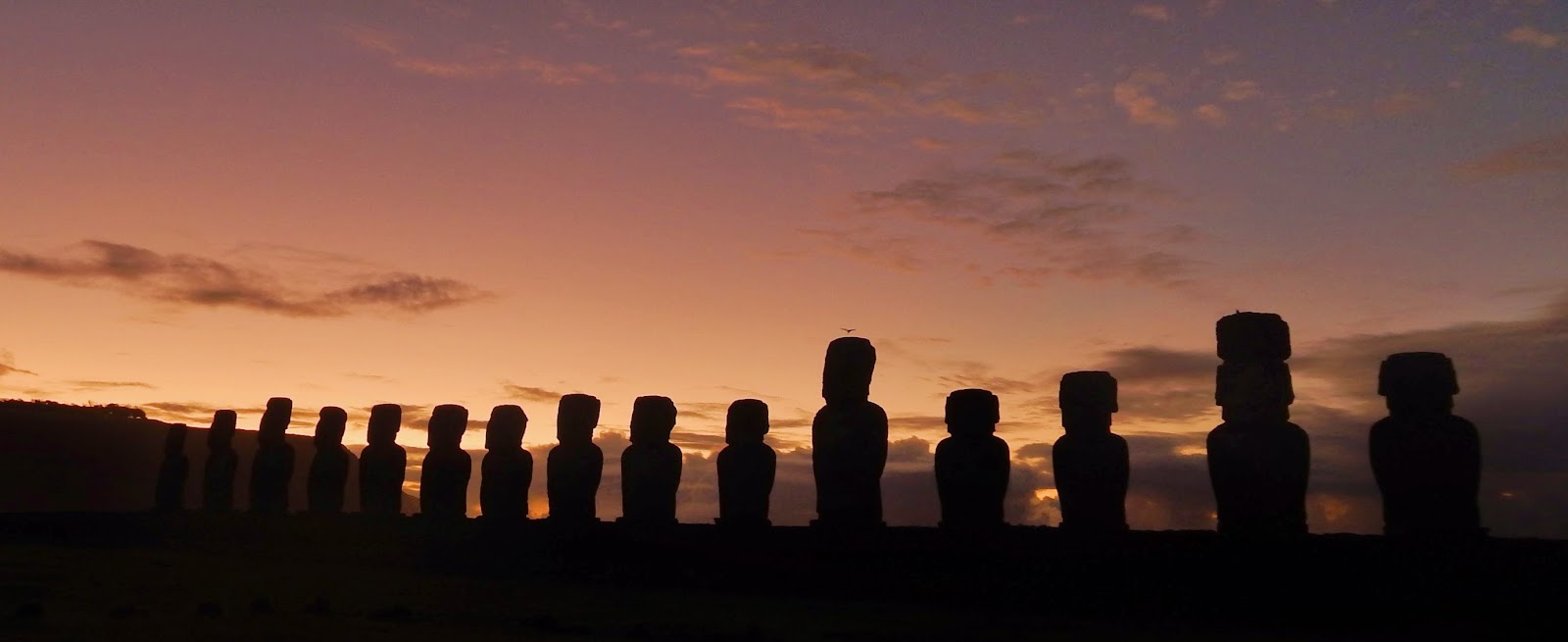

Navigating the dark island was easy, even if signs were put at the turn-off or sometimes after. A few scooters sped past us; anyone who was awake at this hour was heading to one spot: Ahu Tonga Riki. Fifteen moai lined up along the sea. The peninsula we visited the day before would gently block the rising sun behind them.

We laid plastic bags out on the dewy ground, then watched and waited as the silhouetted behemoths looming above us provided the screen for a dazzling light show. That moment when our eyes adjusted and the sky lightened just enough so that we realized we could see the moai gave us goosebumps. The sky slowly evolved from ink-black to deep navy to patches of yellow-white; then just when we'd given up hope of a colourful sunrise, streaks of pink and purple appeared. Captivated by the early morning sun as it hit the cliffs and green craters around us, we lingered longer than most.


Timed perfectly, we arrived at Rano Raraku at 9:01 am. As it opens at 9, we only had to wait 15 minutes for the park workers to unlock the gate. Also known as the Quarry, this is where the moai were cut from the stone of the outer crater wall. Walking around it gave us the feeling that it was truly a moai factory. When they fell out of fashion, the moai were abandoned in various states of completion. Some are vague outlines etched into the mountain, others are ready to be painstakingly shipped across the island, but the most iconic image is of those that had been stood upright in pits to allow for the carving of designs on their backs.


We now know that time and soil erosion led to those pits becoming filled, leaving only a head, and sometimes less, peaking out of the ground at all angles.


The sun was just beginning to graze the edges of the shallow slopes which the moai adorned. Beneath us, we could see "the 15" as the sun hit the waters of the bay behind them, gilding the mist of the advancing tide.


We were completely alone, standing in awe at each new view, inhaling deeply in the hopes that it might help us remember the moment.


Erin was very excited to find the exact spot the picture she had seen as a girl was taken; it was the photograph that instilled in her a desire to visit Easter Island.


We ventured up into the crater afterwards, but disappointingly, the signage was quite confusing and certainly gave us the feeling that the loop around the marshy lake at the crater's centre was off-limits.


A few tour groups pulled up so we quickly left, not wanting our magical memory of the site disturbed. Back on the road, we went to the north coast of the island, stopping to see a few pieces of rock art and a rock with holes in it. The Rapa Nui used to blow into the hole, which made a noise they believed attracted fish to the shore. It was meant to bring good luck to the fisherman.


Our friend at the hostel, Isabel, had previously rented a car and warned us against going too quickly on the small island lest we do everything in half a day. With this in mind, we lingered at the petroglyphs, listening in on what the tour guides were saying in French or Spanish, and took our own quiet moment at the some weird energy rock at the Navel of the Earth (maybe we should've gotten a tour guide?).


By this time, our stomachs were rumbling, along with the gathering clouds overhead, so we high-tailed it to Anakena, the one of only two sandy beaches on the island, to ensure we had at least a few moments of sun in the surf. As the rest of settled in to have a picnic lunch, Craig fought through thick bush to get a view of the moai with the beach in behind them.


Then we all sat on the wonderful South Pacific sand and shared lunch. The next couple hours were spent lying on the beach and swimming in the calm, cool, and crystal clear water. We've read that Anakena had been formed by a tsunami years ago. Legend also states that it was the landing site of Rapa Nui's first settler, Hotu Matu'a. It was also used as a ceremonial place by the Tangata manu (Birdman).


After our home-made lunch and fresh pineapple juices from a stall, we drove around the corner of the rocky outcropping to take a peek at the other, much smaller, sandy beach. O Vahe is a secluded crescent of sand beneath a rocky ledge. It's off-limits for visiting because of the falling rocks that tumble down from the cliff above. We noticed a couple who were ignoring the warning signs and having their own private picnic and swim and tsked them from afar (but were secretly really jealous!).


Heading back south on the island, while looking for a turn-off, we passed a sign pointing to the right with a long unfamiliar name. Since it was nearly completely obscured by trees, we were not sure if it was the correct road or not. We figured we might as well explore. The hard-packed gravel and smooth asphalt of the rest of the drive gave way to mud and deep ruts. At a fork in the road, we stayed on the more well-trod path, though we should have listened to Walt Whitman. A tree had fallen across the road, thus requiring Craig to preform a three-point turn on a hill in the mud. Unphased, we continued on, but were turned back shortly after when the mud turned to wet clay and the jeep began to slide. Winter driving experience helped as the vehicle slowly began to spin. Bringing it to a stop, Craig promptly turned us around and retreated to the main road. That's when we saw that a sign stood to our right, after the turn-off, indicating that no vehicles were allowed on the road. Maybe it is a cultural thing, but we would put that kind of sign before a driver would turn onto a forbidden road.

More fallen moai with rolled away pukao

We managed to find our true turn-off further down the road, which brought us to a rather unimpressive look at the ancient topknot quarry, Puna Pau. After Rano Raraku, it was certainly a disappointment; a few red topknots lay on the grass, lonely without their owners. Topknots, or pukao, were carved from this red volcanic stone, and made to represent the hairdo of the Rapa Nui of the time. Much more impressive when adorning a moai, these hats can be up to 2.5 meters by 2.5 meters. They were carved with a slit in them to sit upon the heads without falling.


The rest of the day was spent driving the South-West road and revisiting the crater Rano Kau that we saw the first day. We attempted to get chicken and chips once again, but were denied the greasy pleasure and instead grabbed groceries for a home-made meal. Kristen, the only one of us who was inspired enough to think of an alternative to chicken and chips directed us so we managed to pull together fried potatoes topped with salami, tomato, green pepper, onion, garlic, guacamole, poached egg, and cheese, with sliced apples drizzled in honey caramelized on the stove-top for dessert.. We broke our detox in order to share a bottle of late harvest we'd brought from Santiago.


Wednesday, May 7, 2014

Day 276: Pitching In


On our first day on the island, we'd visited the Tourist Information Office where we had to pry information about hiking from the woman's protecting grasp. After a struggle, we learned there was a special program running that week that happens only 6 times a year: tourists can go to an otherwise restricted area for rehabilitation to plant trees. We eagerly signed up (as she repeatedly questioned us, "Are you sure?") and we woke up excited on Thursday, ready to take action. It felt great to be doing something collaborative with the local community after months of feeling otherwise disconnected from any one place. We also were thrilled to have the opportunity to offset some of the negatives we knew we were imposing on the island by being there. We had no idea if we would be lugging huge saplings uphill in order to do so, or if we'd be planting one token tree, but either way, we wanted to be a part of it.

Promptly at 8:30 am, we arrived at the school gymnasium for our briefing to discover that no order seemed to be in place. Tourists milled about, and 20 minutes passed without anyone speaking to us. Nearing 9:00, a group of junior high school students came stampeding down the hill, boisterous as in any culture, and at that moment, a member of the Conaf (Cooperacion Nacional Forestal) staff appeared. It was clear that the tourist information woman had neglected to reveal to us that we were in fact joining a school field trip aimed to teach about issues facing the island and provide an opportunity for youngsters to feel proactive.


Pouring out of the vans onto the side of the road, we closely followed the man-in-charge up a gentle slope to a clump of rocks. The unsupervised students ahead of us lounged on the rocks in waiting, or ran off trampling across sensitive ecosystems. We reluctantly sat down, knowing our destination must be further ahead, preferring to continue rather than bake in the sun. We waited nearly 20 minutes before the stragglers in the group had caught up (after their lengthy photo shoot in the tall grass). Perhaps a warning about trip expectations would have helped weed out the non-hikers from the group.


Taking a Break: Easter Eggs
on Easter Island
Another 20 minutes up the extinct volcano brought us to a second resting point in the shade beneath a rocky hilltop shaped like a topknot. By now we were pretty annoyed with the lack of communication about the type of expedition this would be. This was clearly a half day trip that was being extended into a full day; time we didn't have in a week's stay on the island. Begrudgingly we waited for the same group of 4 to lazily make their way up the hill and have their turn at a break. Amidst the frustration and confusion we took time to enjoy the wonderful scenery and views over the island.


We continued on, crested the slope and relaxed instantly upon seeing the view. Wild horses roamed the open plain while puffy white clouds reflections' glistened in the calming waters behind them. Our remoteness was obvious. We stopped again to admire the view and were unsure whether we were meant to eat lunch. We empathized with others we'd met on the bus who hadn't brought along a snack or even a bottle of water, having expected everything was provided (as the tourist information woman had indicated). We'd learned long ago in the trip that "all-inclusive" has very different meanings to different people, and sat down to eat our food, carefully avoiding sitting on the inviting moai benches.


Down the slope, we headed through the surprisingly soft brush, over rocks and into grove of trees. The students ran, jousted each other, pulled limbs off trees and threw rocks, all set to the soundtrack of top 40 songs blasting from iPod speakers. The meaning of our trip into nature seemed a bit lost on them. We breaked at a clearing for ham and cheese sandwiches and juice before getting our orientation of the activity ahead. A heartier lunch for afterwards was being prepared; a Conaf ranger, chainsaw in hand, went and cut down a tree to make a fire to cook chicken over. Putting our net tree gain for the day at -1.

Easter Island was deforested centuries ago, that combined with volcanic eruptions and the windswept nature of the island's position has meant that some areas have never recovered. This has led to severe erosion. After years of study by those familiar with Polynesian plants and Rapa Nui's climate, four trees had been identified as necessary for reviving the island's North-East banks. We would be planting the Aito, a tree known for growing in wild, barren terrain with little nourishment in the soil. After they take root, Mako'i, Dodonea and Albizia will be planted, which will thrive in the Aito's shade and the protection from the wind they offer. Conaf seemed well-prepared for our arrival, with hundreds of holes drilled in the dry, rocky soil and seedlings and handfuls of fertilizer resting beside each planting place. We were given a demonstration of proper planting technique, including building a small retaining wall around each tree to ensure the rain didn't just wash away the freshly disturbed soil, then the 70 of us took to work, planting 1400 saplings in the span of an hour.

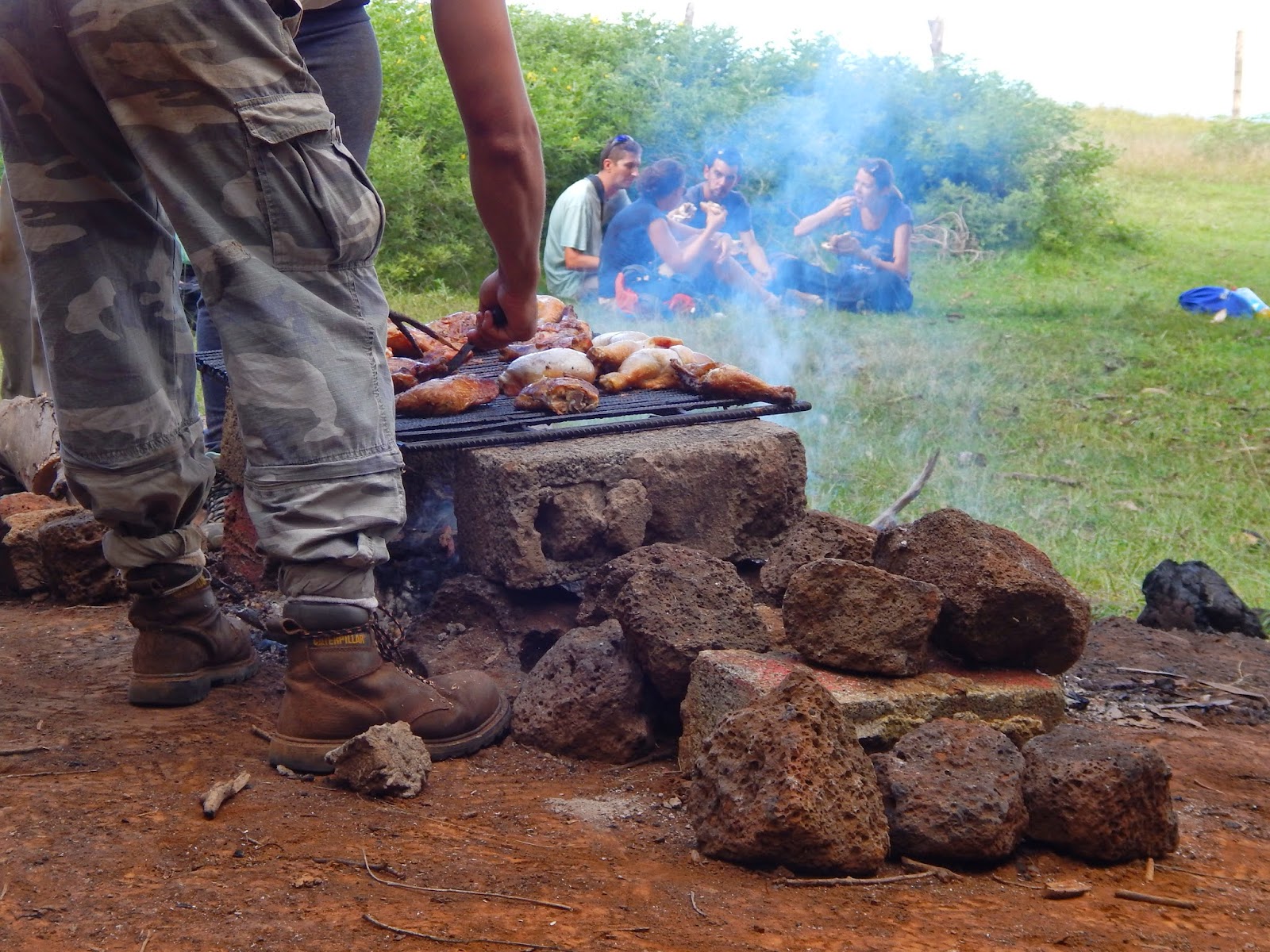
We regrouped in the clearing for a lunch of grilled chicken. The experience seemed to lack instilling of the core practices of naturalization, but hopefully we did more good than harm. After more waiting around, we hiked 5 km more around the other corner of the triangular-shaped peninsula. We led the pack of people and made it just before the rain started to pour down.


Caked in dust, the four of us walked the main strip, hoping for a repeat of the amazing chicken and chips we ate the first day, but it wasn't in the cards. We returned home to make more plain rice and couscous, eating it as we watched a spectacular rainbow frame the ending of our day.