Tuesday, May 6, 2014

Day 275: Spelunkin' & Splashin'


Not wanting to push ourselves too hard, we set a start time of 9:00 (the sun doesn't rise here 'til 8, so that's actually relatively early). Craig flagged down a taxi and we took it out to Ahu Akivi, a row of moai a few kilometres north of town.

What should have been a moment of reverence, as we were the only tourists there so early, was broken by the troop of grass cutters intent on cutting every blade one at a time. They blazed their way up and down the field in front of the moai and even on the ahu, slicing up the beautiful wild flowers that grew between the monoliths. Our carefully edited photos provide you with a look at how peaceful it should have been.


Intent on waiting these guys out, the two of us hung around longer than Kristen and John had the patience for. They finally gave us a little wave and headed for the trailhead of the highest volcano on the island, Tere Vaka. We felt that the sun had already risen too high and was beating down quite strongly to begin such a climb, so we opted to enjoy exploring the north road on our own.


We walked back down the road a ways to a poorly signed fork, hoping that it was the direction we wanted to go.


It wasn't long before we came upon three rental cars parked along the side of the road. Investigating we found what would become a common sight, an informational placard that had been painted over, obscuring all tidbits of knowledge. Unsure of what the significance of the various piles of stones was we continued on our way.

Our next stop was once again void of information. Apart from possibly a sign marking a point of interest, you will not find any information or sign posts along the north road. A little bit of wandering led us to the entrance of a cave.

Thinking ahead we had brought our headlamps but noticed once we turned them on that both were on their dying legs. We proceeded with trepidation. The cave continued for maybe 500 meters before emerging in a field.A quick scan of the horizon for the road and a few guesses had us back on track.


We reached the coast and nearly walked past some of the stoic heads of toppled moai strewn along the ground in and amongst the grass and stones of the burial mounds on which they were erected. These stone giants created a mystical atmosphere; we felt like explorers stumbling upon the ruins of an ancient civilization as we found more heads as we walked through the footprints of now crumbled homes. With no sign of any other human activity and the waves thundering against the rocks below us it was a marvellous spot for a picnic.

Rather than return to the road we savoured the isolation a little longer as Craig spotted a trail that ran alongside the cliffs, at a safe distance Mom and Dad. The trail curved towards the edge and stairs appeared under our feet. The brief descent brought us to the smallest cave of the day. From the edge we enjoyed an expansive view of the cliffs in both directions.


Trying to remember what still lay ahead we thought there should be one more cave. Our eyes swept back and forth across the dusty landscape for any signposts and an indication of which of the many splintering trails would most likely take us where we needed to be. The advantage of a tiny island with few trees is that it is difficult to get or stay lost.

 We stopped to watch the waves carve through a cavernous rock just offshore. Each wave wound its way through the core of the small island while the rest crashed against the sides. Offered a brief repose the water that had made its way into the nooks and crannies poured out in splendiferous waterfalls; different each time, and each only lasting a moment before being washed away to create a fresh canvas.


The entrance to the last cave of the day, Cave of Two Windows, was uninviting. As Craig slithered through the tiny opening his body blocked all light from his headlamp, thus his feet nervously searched for the next step. Once through and into the cave the ceiling was little more than 3 feet high (~1 m) and at times less. Every step was followed by a scan of the slippery ground for the next safe foothold, and then looking up to find the low point most likely to cause a head injury. Finally able to stand up we reached a fork where we cautiously proceeded down both small slopes to openings in the cliff that dropped into the sea.


We slowly re-entered society, saying hello to those we passed, back on the road weaving between houses. Looking out over a large field, out to the sea, a row of large moai stared back at us. We had passed a few tourists on the road, but had been alone for the most part, now we were at a tourist attraction and the familiar rapid clicking of shutters challenged the roar of the tide.

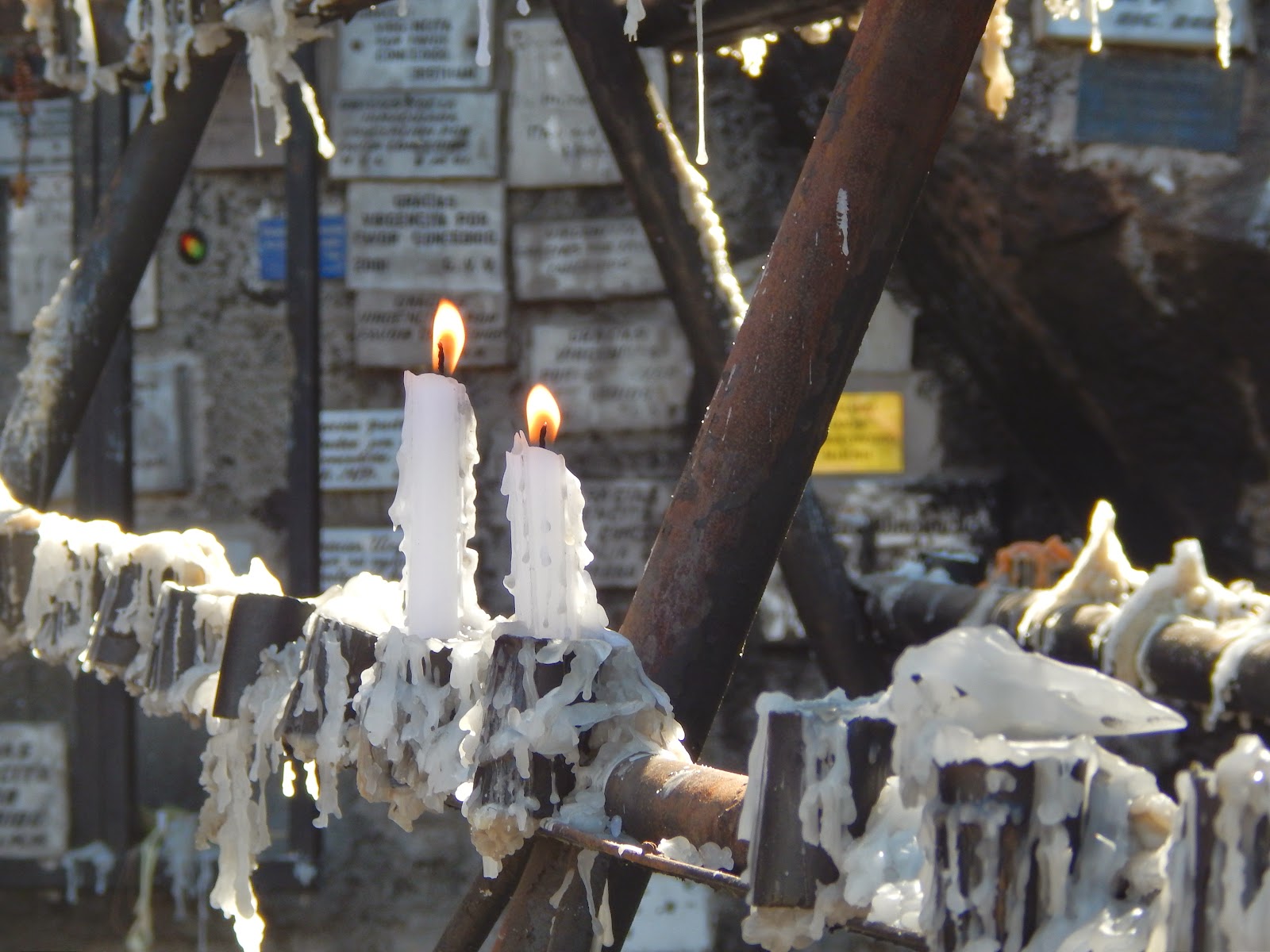
Another half block brought us to the festive cemetery, coloured using a full palate and decorations. Each grave/small shrine stood as a reminder of what the person cherished most in this world, it was to look at an ancient (by technological time) precursor to facebook or myspace. Scarves of their favourite soccer team, posters for cherished memories, pictures with friends and family, and artificial flowers adorned each tomb.

Too tired from our long day to visit the museum that was put off for another day and we returned home.


All in all, it took us roughly five and a half hours to walk the whole route and we were thankful at the end of it that we had started the day with a taxi ride as opposed to more walking.

John had tossed around the idea in Pucon that we take a week on Easter Island to detox from all the Chilean wine we'd been enjoying and we'd scoffed at his suggestion at the time. We figured we could do that after we parted ways and weren't in the presence of such great, cheap beverages. However, it was starting to appear that our time here would be booze-free as everything from liquor to potatoes was twice the price of Santiago (or home), and our level of activity necessitated early mornings and thus good nights' sleeps. If only we had the money to make something more than plain rice sans meat or vegetables, then we'd likely be feeling the healthiest of the whole trip!


Sunday, May 4, 2014

Day 274: Iorana Rapa Nui


As we set off from our hostel we noticed a crowd forming along the shore. As we neared and Craig spotted the boat that had been tossed onto the jagged rocks it was clear that something terrible had happened. 100 m further down the shore a group of men had formed a rectangle on the rocks with waves crashing around them. The community gathered to recover the boat, but nothing could be done for its captain.

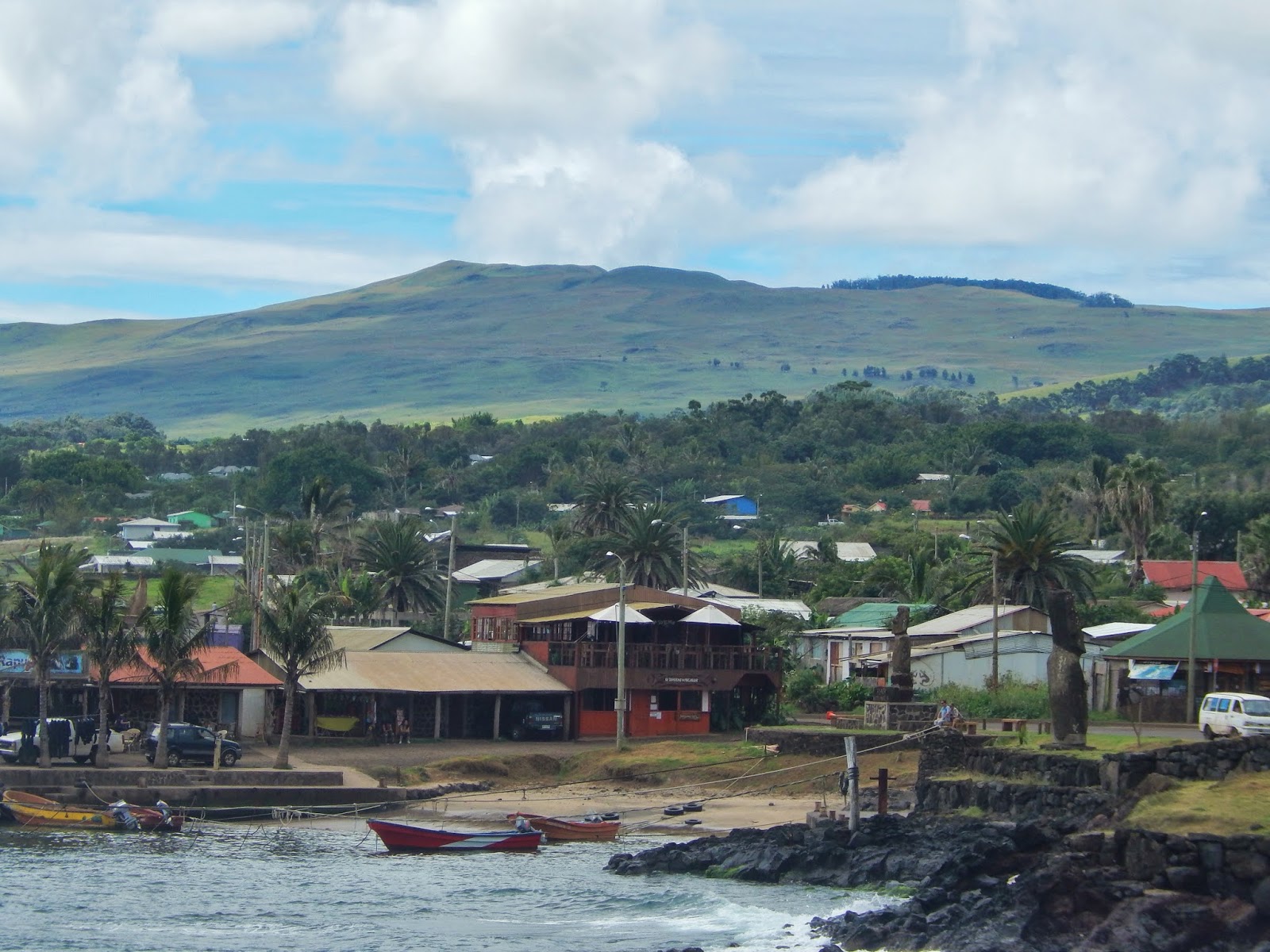
We sombrely continued along the coast heading to the South-West tip of the triangular island. We passed the harbour and the moai standing sentinel over the nearby houses.


From there, it was a steady climb up the steep hill, past homes, the island's nursery, and through a clump of trees. Then there was nothing to stop the sun from beating down on us as we trudged up the volcano's exposed slope. We crested the ridge and looked down on the crater, Rano Kau.

Here, a brief pause for snacks and water was in order as the tropical heat was wearing us out. We had left shortly after breakfast to try to beat the heat, but somehow we still managed to be hiking up the volcano right during the peak of the sun. The four of us traversed the rim, walking through long grasses and brush to reach the old ceremonial village, Orongo.


Orongo is made up of 54 houses which are built right into the rocky cliff. After being visited by explorers, the ancient religion that the islanders revered (where they created burial platforms known as "ahu" with "moai" perched atop them) lost followers. Researchers believe that the islanders toppled the moai after their previously passed-down beliefs had been shattered by the arrival of other human beings. Later, at the end of the 16th-century, a 'cult' formed that believed in a bird-man religion and worshipped a god called "Make-Make".


Orongo was a village that formed from these worshippers, and was used only a few weeks out of the year. In Spring, the revered bird, the "manutara" (or Sooty Tern) arrived on a small islet named "Moto Nui" beside Easter Island to lay their eggs. The chiefs of each tribe (or a representative) would face strong waves and sharks to swim out to the Moto Nui after scaling down the cliffs and camp there for days or even weeks. The first participant to find an egg of the manutara would be adorned the title of "tangata-manu" (or, birdman). He would spend the next year in isolation, allowed only to talk with a priest and restricted from even cleaning himself. The last competition took place around the year 1867. Details on what the benefits was were a little hazy.


It was an interesting walk through the village remains thanks to a detailed pamphlet from the Orongo museum, but not much is left of this historical site. It's positioned in a spot high on the cliffs between the ocean and the crater, making it vulnerable to erosion.


It didn't take us long to half-jog our way back down the hill. We treated ourselves to a late lunch at the seafood restaurant we'd passed on our way up. The two of us shared fish with a delicious mango sauce and rice. The view out at the crashing waves couldn't have been better, and we arrived home feeling satisfied with our big outing. We were a little relieved when we saw that the sunset had nothing to compare to last night's so we didn't feel guilty for not walking up the road to the sunset spot behind the moai north of town. Sitting at our hostel's edge watching the sun go down for another day was good enough for us.

Saturday, May 3, 2014

Day 273: An Easter Treat


We tried, with limited success, to shake the grogginess that comes with waking up well before sunrise after a day full of 'sampling' wines. Our excitement was high as we boarded the plane and were treated to a sunrise flight over Santiago. We passed the 5 hours aboard the aircraft by watching movies and occasionally peeking out the window at the never-ending Pacific beneath us. As we made our descent we strained to try to see anything besides water. Then suddenly the tiny speck of an island interrupted the monotony of blue in all directions.

Passing over Rapa Nui, or Easter Island, before coming in to land gave us stunning views into a crater, across the rolling volcano hills, and of the 300 meter cliffs that protected the island from the sea.


Our hostel was situated across the road from the ocean.  Rapa Nui is the most remote inhabited place on earth (from a distance to the nearest human settlement point of view), we were 3,800 km from Chile, and 4,100 from Tahiti (Pitcairn Island is the closest at only 2,000 km away and has 50 residents). Besides a few large rocks that rise from the sea within swimming distance, the nearest, uninhabited, island is still over 400 km away.


Rapa Nui rises from the sea, alone, challenging the sea's dominance. The mighty Poseidon has not taken kindly to this; we watched as powerful waves grew in strength throwing themselves against the island, pulling it back into the depths bit by bit. With all of the volcanoes now extinct it is only a matter of time before the sea reclaims its territory.


In our brief exploration of town we found a wonderful Chicken n' Chips joint and saw our first two Moai, the iconic stone statues which are spread throughout the island.


We made it back home in time to watch one of the more amazing sunsets we have seen.


We were all hungry, desperately waiting for dinner, but we could not tear ourselves away to start cooking as the sky continued to dazzle for well over an hour. In only our few first hours on the island, we'd been treated to threads of its magic, and we knew we wanted more.


Friday, May 2, 2014

Day 272: The Devil's Cellar


A few metro transfers brought us to the far flung edges of the expansive Santiago suburbs. We had ventured so far from home in order to visit the Concha y Toro vineyard. The overpriced tour started by walking us through the grounds of the original owner's estate while telling us some of the history. The grounds were as well-groomed as the guide's descriptions. Horses roamed by man-made ponds and the fall colour was in full force. We couldn't have asked for better weather.


More than just the history of the grounds, we also learned about Chilean wine. As we'd previously read, Chile's "little darling" grape is Carmenere. Originally grown in Bordeaux, the world thought this wine was extinct due to a phylloxera infestation in the 19th century (a tiny insect that attacks the vines). In 1994, it was discovered that the grapes had actually been planted years earlier in Chile. Mistaken for Merlot, wine critics hadn't been able to understand why Chile's Merlot tasted so different from those of other regions. An expert came to examine the leaves, and, voilà, Carmenere was re-introduced to the world. We now know one good reason why the officers at Chilean border controls are so strict...they are trying to protect their little beauty from further harm by the phylloxera.


Our next stop was the highlight for us. A small cluster of vines arranged in a circular plaza offered the opportunity to pick grapes off the vine and taste the different varieties. These grapes would make terrible wine as they were grown to be edible, but it was fun to taste 'wine' in a different stage.


Next came the "real" tastings. We tried three: a white blend and two reds, then toured the cellars, where the Devil himself is rumoured to live. We were never told any specifics of the legend but we did get to watch a hilarious video/light show projected on the cellar's wall ("You're a genius Mr. Concha y Toro", "Yes I am"...). This cellar is where they keep their best wine, in first-use French oak barrels. The cellar has even remained untouched from Chile's terrible earthquakes.


As nice as it was to walk around the lovely vineyard, we felt that our money could have been put to better use buying a few nice bottles of wine and tasting them ourselves. And it doesn't hurt to have a nice meal on the side. We'll have to keep that in mind as we travel onwards to the wine mecca of Mendoza.


After watching the Master Sommelier documentary, Somm, we were all well-equipped to smell, swirl and taste like experts.


Thursday, May 1, 2014

Day 271: Girls and Guys


Nearing 300 days of travelling solely as a couple means it's nice to have a day apart. With Kristen and John at our sides, it was easy to both have a day out in the company of others. The guys took off to watch a fútbol game while the girls headed up Cerro San Cristóbal. Here are our respective recounts.

Erin
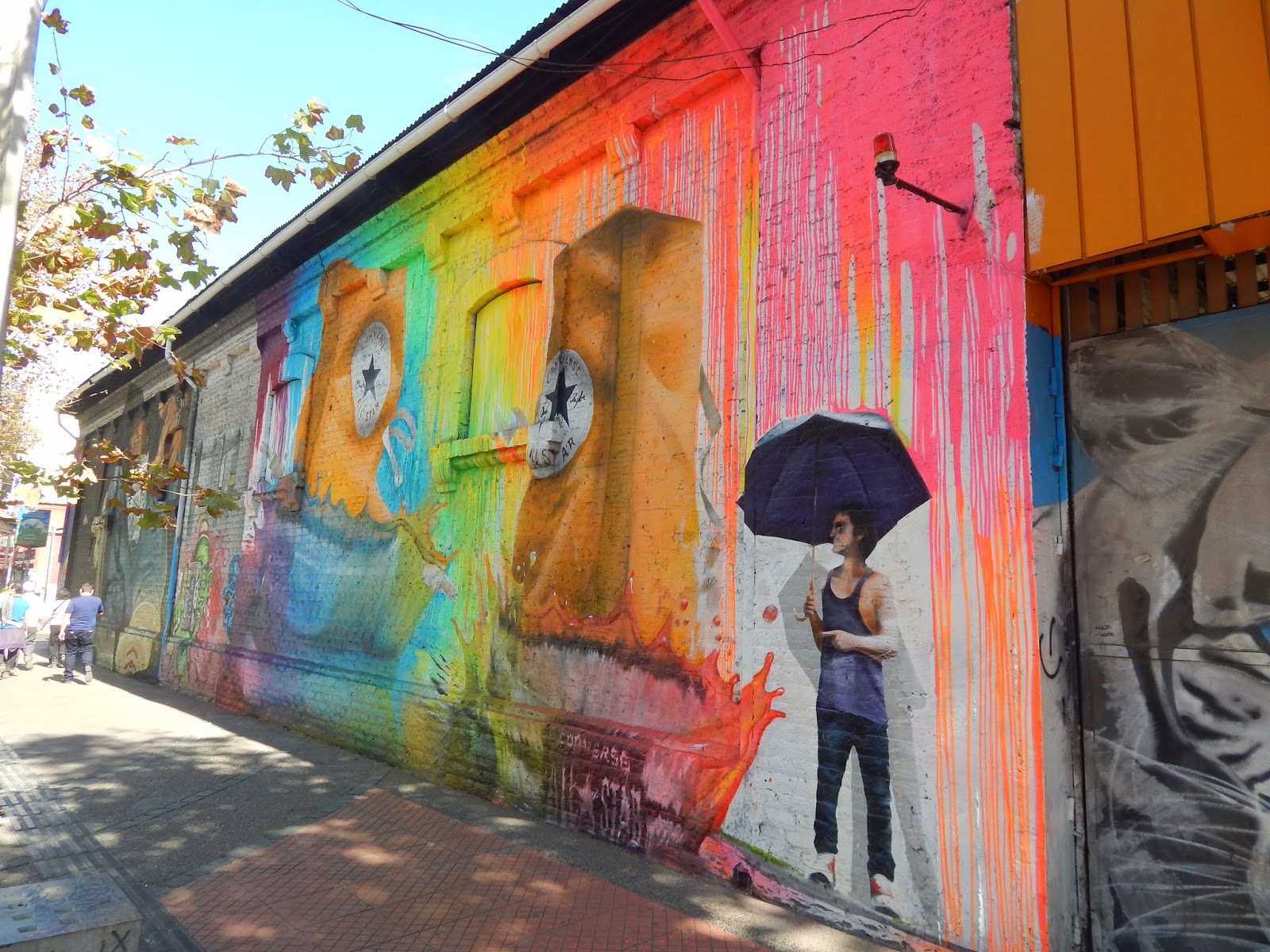
It was the perfect day to be outside. We were early enough that the air was still crisp but the sun was shining brightly overhead, promising one of the clearest days we'd had. Kristen and I strolled along the many pedestrian streets, pausing to take photographs of street art or beautiful architecture. The neighbourhood below the hill, Bella Vista, had many enticing restaurant patios and balconies opening up for the day. We dreamt of a post-climb pisco sour.

The Cerro itself certainly provided us with a good workout as we wound our way along the road at its base before climbing a series of switchbacks on a walking trail. But it wasn't any kind of quiet time in nature. Families flooded the trail, perhaps more than usual due to it being Easter weekend. We even saw a balloon launch from the top! The Cerro also boasts lush parkland, Japanese gardens, a funicular and a zoo. But, it's main attraction is a 14 m high statue of the Virgin Mary at its peak.


We paused to admire the city views, with the Andes just peeking in behind, and have a snack. Then we jogged back down the trail stopping only once, to give a wide berth to a furry friend that a fellow climber found on the trail.


Kristen led us to another pedestrian area filled with patios and little tourist shops where we stopped for picadas (of yucca, carne, corn patties and guacamole) and a real pisco sour (just for you, Diane!). No more pre-made stuff for us!


Just like in Barrio Brasil, we let our feet and eyes do the leading. We wandered the artsy streets, leaving maps or plans behind. With the rough idea to start walking home, we crossed the ravine and caught a glimpse of the Plaza a la Aviacion and its dancing fountains. I've tried to find the significance of the statute online with no success.

Having given the guys a curfew of 5 pm, we got giggly when we realized it was nearly 5 and we were still out ourselves. We were pleased to hear their voices as we approached our apartment, meaning they hadn't been murdered at the soccer game, and that it didn't look to them like we'd been sitting around waiting for them to come home. What a great girly day!


Craig
John and I looked at maps ahead of time to know the way to the football stadium. Neither of us bothered to look at the crossroad though and thus were stuck following a gentleman wearing the kit of our adopted team, Palestinos, in the hope that he was going to the game.

Palestinos was started by Palestinian immigrants in 1920, they recently made the news when they changed all of the number 1's on their jerseys to maps of Palestine. Being unsure of the metro system we gave ourselves extra time and thus arrived at the ground much ahead of time.


It was the final game of the season, and as Palestinos was securely in 4th, the game did not draw a large crowd. The match was fast-paced and exciting, but our fellow fans were quiet, and our boisterous shouting in English was pretty noticeable, only the opposing fans seemed to have their hearts in it. In the end, our brave freedom fighters were not able to put one past the opposing keeper who was backed by the slanted refereeing and we fell to Iquique 1-0.


Us
We finished up the day once more by watching another gorgeous sunset from our rooftop while cheersing this wonderful life with a glass of bubbly. With dinner, we enjoyed the fancy bottle of red we`d bought at the Balduzzi winery in Talca where we learned there is an italian grape variety known as `Tears of Christ` that adds the heavy red colour to the wine. It felt appropriate to drink on Easter weekend.